
Margaret posed us a doozy of an Inkling challenge this month. She shared a new poetry form, called a Pythagorean Poem, created by Shari Green. Here’s the description she shared,
“Pythagoras’ theorem is a2 + b2 = c2. One possible “triple” is 3, 4, 5.
3×3 + 4×4 = 5×5
9 + 16 = 25
Using the triple, the poetic form works like this:
1st stanza: 3 lines of 3 words each
2nd stanza: 4 lines of 4 words each
3rd stanza: 5 lines of 5 words each, and this third stanza must be composed of all the words found in stanzas one and two (in any order; variations okay). The third stanza should be a progression of sorts, a product of the first two in thought or theme or meaning.”
Easy-peasy, right? Eep!
Writing this poem felt like a construction process, and one in which I finally ended up deciding to live with the result at a certain stage, even if it didn’t quite match the vision in my mind. In the final somewhat desperate construction stages (deadline approaching!), I turned to the computer to color code words to keep track. It ended up looking like this:
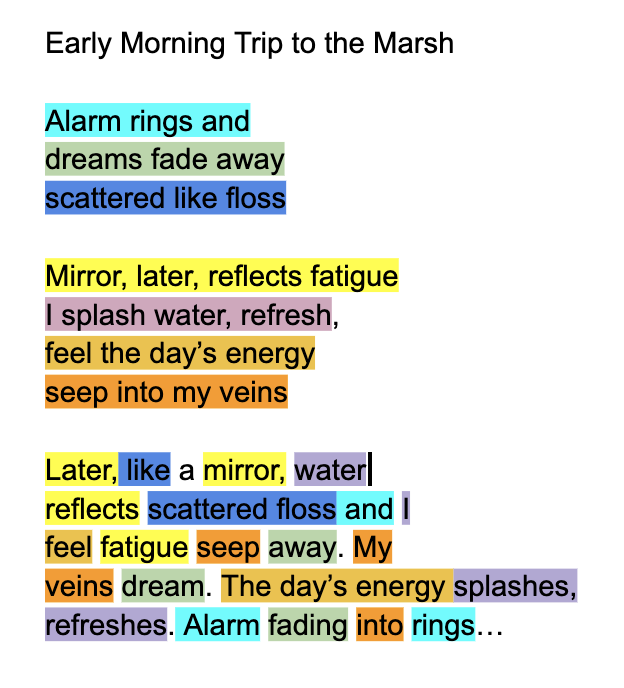
Early Morning Trip to the Marsh
Alarm rings and
dreams fade away
scattered like floss
Mirror, later, reflects fatigue
I splash water, refresh,
feel the day’s energy
seep into my veins
Later, like a mirror, water
reflects scattered floss and I
feel fatigue seep away. My
veins dream. The day’s energy splashes,
refreshes. Alarm fading into rings…
©Molly Hogan, draft

Here are my final thoughts on writing this poem:
Pythagorus
This polymath known through the ages
was surely the wisest of sages.
His hypoteneuses
still guide building crews as
they construct skyscrapers in stages.
But when building a poem, I must say
his ideas lead from stable to sway.
Though I build a strong base
with each word in its place
true coherence keeps slipping away.
©Molly Hogan
Thanks, Margaret, for the challenge!
If you want to see what the other Inklings did with it, please check on these links:
Mary Lee Hahn @ A(nother) Year of Reading
Catherine Flynn @ Reading to the Core
Heidi Mordhorst @ My Juicy Little Universe
Linda Mitchell @ A Word Edgewise
Margaret Simon @ Reflections on the Teche
Then, head over to Poetry Friday! The wonderful Tabatha Yeatts is hosting this week at her blog, The Opposite of Indifference.
 Nix the comfort zone
Oh my goodness, Molly. The Pythagorean poem was very good, but I liked your follow up even more, which made me chuckle.
“Though I build a strong base
with each word in its place
true coherence keeps slipping away”
Yes! What a chalenge!
Thanks for sharing.
Cathy
LikeLike
[…] Mary Lee Hahn @ A(nother) Year of ReadingCatherine Flynn @ Reading to the CoreHeidi Mordhorst @ My Juicy Little UniverseLinda Mitchell @ A Word EdgewiseMolly Hogan @ Nix the Comfort Zone […]
LikeLike
I feel your frustration, but I actually love how that last stanza places you in your happy place, the marsh, staring into the water to fulfill a peaceful sense of self. Thanks for taking the plunge with me.
LikeLiked by 1 person
I really didn’t mean to come across as frustrated. This was definitely a mind-bending challenge for me, but it was an interesting one. It made me think a lot about poems and forms and meaning, etc. All good things! Thanks for posing it!
LikeLike
The topic you chose works very well– energy, fatigue, and dreams all circling each other like water rippling. And your Pythagoras poem holds steady!
LikeLiked by 1 person
Thanks, Tabatha! I had a few things I wanted to rework, but I couldn’t quite figure out how to do it and maintain the form. It was a good puzzling poetry building activity! And thanks for hosting this week, too!
LikeLike
Ah, Molly! Brava for both the equation-poem and the post-poem honesty! Both incredibly creative!
LikeLiked by 1 person
Thanks, Patricia! I love how the challenges push me into new places.
LikeLike
I love the double meaning, at least to me of ‘alarm’, Molly. Ah, the ending “Alarm fading into rings…” And it is fun to see the color-coding, too!
LikeLiked by 1 person
Thanks Linda. The color coding worked well for me. It was interesting to take on such a demanding form and try to maintain some meaning.
LikeLike
That color-coding is so smart! What a challenging form you all took on!
LikeLiked by 1 person
My brain feels a bit twisted, but in a good way. lol I find myself thinking of other possible topics and how they might work in this format. I suspect, even though it was very challenging, that I might try it again.
LikeLike
That photo is just stunning! I love how your poem came together. You even nailed that elusive (for me, anyway)progression. Wow! I’m feeling the fatigue seep away too. And, veins dreaming…that’s pretty amazing. Well done!
I got out a spreadsheet and crossed out words as I used them. That third stanza is tough!
Love the silly poem about a polymath. LOL.
LikeLiked by 1 person
Thanks, Linda. I had some tweaks I couldn’t quite figure out how to make without the whole construction tumbling down. It was such an interesting form to work with. I agree that the third stanza is especially challenging! What a great mind-growing challenge! It felt refreshing to write a limerick or two afterward 🙂
LikeLike
Your poem is lovely, Molly. Isn’t it interesting that we both began in our dreams? Thank you for the chuckle from “true coherence keeps slipping away.” That’s exactly how I felt as I wrote my final stanza!
LikeLiked by 1 person
That final stanza was tricky! I love how naturally your poem flows and I’m always a sucker for anything about owls.
LikeLike
As I read more of these examples, I realize how challenging the form is and how creatively each poet has met the challenge. Love how you took us from waking to the water. Well done! And thanks for the bonus poem, too.
LikeLiked by 1 person
Thanks, Rose. This one was such an interesting process. I feel like my brain got stretched a bit!
LikeLike
You all are stunning me with these Pythagorean poems! I love the mood of the Pythagorean poem and love the brutal honesty of the second one. 🙂
LikeLiked by 1 person
Thanks, Karen. Believe it or not, I might try one of these again sometime.
LikeLike
I believe it. 🙂 The form itself is appealing in its challenge. If I’d been presented with the math and told to figure it out, I’d say nay. 😀 But the breakdown and prescription make for such an interesting form!
LikeLike
Well done, Molly! I love your dreaming veins and your clever second poem too. Going from stable to sway – what a great image!
LikeLiked by 1 person
I always love writing limericks. I spent a lot of time with my dad as he was dying, and that was a favorite activity. It’s a form that typically flows for me, and never makes me fail to think of him.
LikeLike
Molly, for being frustrated, I think your poems are well-done. The post-poem has a bit of humor: true coherence keeps slipping away.
LikeLike