
Writing Club

slice-of-life_individualI finally decided to do it. I had hemmed and hawed for a long time before committing,  but finally I did it. I signed up to become…the Writing Club Advisor. Eek! I wasn’t at all sure that I wanted another school-related thing on my plate, yet I wanted to share my love of writing with students in a “freer” zone. Sure, the kids in my classroom know I write and I share that process and my enthusiasm on an ongoing basis. However, I can’t say I’m in love with essay writing and it seems to have a bit of a strangle hold on the fourth grade writing curriculum. 

Ok, I feel guilty even writing that. I need to work harder to feel the essay love!  There really are parts of essay writing I love…the feeling of finding just the right compelling evidence, the perfect quote, the stirring lead or satisfying conclusion. There’s a lot to love. But overall the genre is not what stirs me to write, and we do a lot of it. Maybe it’s the fact that my own life isn’t spiced with strong opinions. I’m more inclined to find a common ground than to take a divisive or rebellious stance. Is personality trait something that influences genre preference?

At any rate, I took the plunge and created and posted flyers for Writing Club. I deliberately did not send notices home with students. I didn’t want parents to sign up their children. I wanted students to self-select to be in this club–Students who are motivated to come and write.

Then I sat back and waited to see if there would be any response. And there was!  Ultimately, 23 kids from 4th-7th grade signed up! Wow! I debated about capping the group as the forms trickled in, but just couldn’t bring myself to do it.

Last Tuesday was our first meeting. After a truly impressive amount of after school snacking (writing is hungry work! Well, pre-writing really…), we formed a circle on the carpet. I gave a brief introduction and then said, “So, let’s start by getting to know each. Can you introduce yourself and say why you signed up for Writing Club?”

If you ever need a cure for teacher burnout, sit in a circle of motivated student writers and listen to them all state some variation of “I’m here because I love to write.” My personal favorite was, “I want to write stories to inspire other people.”  Or maybe it was, “I’m here because I really want to write, and…..(very long pause)…and yeah, I really want to write!”

We started with a prompt. For ten minutes, the room was silent other than the scratch of pen and pencil and the shuffle of notebook pages.  Another antidote for burnout–Capture that sound and sell it on Teachers Pay Teachers!

I’m so glad I finally decided to do this.

Next Time, Engage Filter

slice-of-life_individualTired of doing the cobra dance from behind students, trying to see their writing in that elusive middle distance through my bifocals, I’d finally decided to opt for progressive lens. After helping me pick out my new frames, the woman at the eye doctor’s outlined my options, detailing what my insurance would pay and what it wouldn’t. She managed to convince me pretty easily that I should go with the newest technology. (Yes, of course, the one with the skimpy insurance coverage. Ouch!)

“Do you want transitionals?” she asked, then elaborated at my blank look, “You know, the ones that change into sunglasses when you go outside?”

“Oh,” I said. “Oh, no, I don’t want those.”

“Well,” she said, “if you do choose those, there’s a package deal available. If you have three options selected –and you already have two–and add transitionals for only $25, you can get a free set of lenses and pay only 75% of the frame price. It’s a great deal!”

“But I really don’t want transitionals,” I said.

“So,” she confided, leaning closer over the table, “here’s what you do. You just say you want transitionals now. Then, when they come in, you tell me that you don’t like them, and I send them back and they’ll make you a new pair!”

“Oh,” I said. “I don’t know about that.”

“It’s no big deal,” she said, “I do it all the time!”

She looked at me  expectantly, hand poised over the mouse. I sat there feeling uncomfortable. Squirmy.  Should I? Shouldn’t I?

“You’ll save hundreds of dollars,” she reminded me as I hesitated, trying to organize my thinking and my response. I really did need a new pair of sunglasses, and that was a huge savings, but it just didn’t feel right.

“No,” I said, “I’m sorry, but there’s something about that that just hitches up against something ethical inside me. I just don’t like playing games or playing the system and am really not comfortable doing that.”

Then I heard my words in my head again. And cringed.

Oh.

Silently, I rebuked myself, Oh, Molly, why did you say that? You could just have said, “No, thanks!” Did you have to use the word ethical? Didn’t you just essentially tell her that she was being unethical? Ugh.

“I appreciate your telling me about the option, though,” I said aloud, quickly, smiling, hoping to make amends.

“Oh, that’s fine,” she said, coolly. “I just wanted to let you know.”

I bobbed my head up and down, vigorously. “Yes,” I said, “and I really appreciate it! It really sounds like a way to save a lot of money! Quite a deal! ” Stop babbling now, Molly…

After another year or two   fifteen minutes or so, we’d finally finished ordering my glasses (sans transitionals!), and I left the store, still inwardly shaking my head about my ill-advised comments. Why, oh, why did I say that?

Two weeks later, I’m still waiting to hear that my glasses are in. I’m beginning to wonder if perhaps the order was sabotaged…

Kids Write the Darndest Things!

slice-of-life_individual“Can you drive on the way back so I can get some school work done?” I asked my husband (and heard a faint echoing chorus of too many teachers saying similar things on a Sunday afternoon after a busy fall weekend.)

Kurt nodded and changed direction, heading to the driver’s side of the car. I climbed in and organized my papers around me in the passenger seat. Moments later we were on our way.

What to start with first?

I shifted through papers and sighed, wishing I were merely admiring the passing scenery, but knowing I simply had to get some work done. Finally, I pulled out the Habits of Work reflection my students had completed on Thursday. I needed to look through them and give feedback. Not too mentally demanding, but it had to be done. A good place to start.

With our Habits of Work, we have each student assess  himself/herself as “Not Yet” “Sometimes” or “Yes!” on four categories: Respect, Preparedness, Engagement, and Determination. Students who score themselves a “Yes!” in a category have to note evidence of how they show that particular strand. After reflecting on all four habits, students create individual goals.

As I read and marked, I was impressed by the detailed responses. Overall, my feedback was in synch with how students were rating themselves. The kids were giving thoughtful evidence and often noting specific areas to work on. For example, one student, explaining why she scored herself a “Yes!” on engagement, focused on partner work, writing, “I ask questions to try to understand what they are thinking.” Another wrote, “I raise my hand and share ideas.” A different student, commenting on determination, wrote, “I ask for help when I need it and try when things are hard. I need to take feedback.” I read through, enjoying the insight into their thinking and appreciating their efforts, getting to know them just a little bit more.

After a while, I looked up, taking a break to check out the rolling hills and sun-dappled landscapes. It was a picture perfect day–stunning New England early autumn in all its glory.

Taking a deep breath and gathering up my will power once again, I turned away from the window and back to my work. I was happy to see I’d made good headway through this particular pile and had only a few papers left. Turning to the next one, I glanced to see who’d written it, then began to review it.

“What!” I yelped and then burst out laughing.

My husband glanced over. “What’s so funny?” he asked.

I looked down at the paper again, shaking my head, laughing even harder.

“OMG!” I said, “I can not believe what my student wrote!”

“What is it?” he said.

So I read it to him, and he laughed just as hard as I did.

71006436_390093658589388_9156753731134423040_n.jpg

Oh, my! I don’t think it’s going to be a boring year!

What was that?

slice-of-life_individual.jpgI struggle up from beneath thick layers of sleep.

What? Huh?

I hear a series of thumps and a murmur of voices.

What? Is that coming from outside? Is someone here? What’s going on?

Blearily, I look at the clock. 12:37 am. Living at the top of a hill, we don’t have stray visitors and most assuredly not at this time of night. Who could it be?

“Someone’s here, Kurt,” I say, turning toward him as he sits upright, clearly also wakened by the noise.

Knock! Knock! Knock!

“I think someone’s at the front door,” he says, groggily.

 No one uses the front door in Maine…Has there been some sort of accident?

Kurt (aka “The Brave and Impetuous One”) throws back the covers and gets out of bed, heading downstairs. I (aka “The Cowardly Prudent One”) move over to the window and peer out into the dark, trying to see what might be going on. Is that a car in the driveway just past the corner of the house? Are those lights or moonlight? I strain to listen, but hear nothing. 

Long minutes pass.

Who’s out there?

Where did Kurt go?

What is going on?

Suddenly, a hushed voice murmurs, “I think I see movement.” Then I hear the rustle of people moving, and see the sweep of a flashlight’s beam over the yard. 

I call down through the open window, “My husband’s on his way out.”

“Oh! Hello?” a woman says. “I’m sorry it’s so late, but I think I have your cat.”

“What!?!” I exclaim. 

“I found it on my porch when I came home tonight. I recognized her picture from your “Missing” post on the town Facebook page. She’s grey with a tan dot on her head, right?”

“Oh, my gosh! Yes! Is she okay?”

“She seems fine. We…”

“I’ll be right down!” I cry, cutting off her response.

I race down the stairs and into the family room as Kurt is pulling the door closed, coming back into the house.

“What are you doing?” I say, trying to get outside. “Someone found Squirrel!”

“What? No way!” he says, “I called out, and no one answered!”

“They’re right at the side of the house,” I say, pushing him out the door.

We rush through the garden and around the corner of the house. There, in the lights of a car we can see the shadowy silhouettes of a woman and a young man.

“I’m so sorry it’s late,” the woman repeats. “My son and I found her on our porch.” She continues, “I would have kept her for the night, but I’m so allergic to cats. I messaged you, but it’s late and you didn’t answer, so I googled your name and your house came up on google maps, so we thought we’d give it a try. She’s just in the back of the car.”

While she speaks, her son opens up the car and lifts out a laundry basket covered with a towel. He sets it gently on the ground. As he pulls back the towel, a dark shape bounds out. Kurt grabs, catches her and lifts her up into into his arms.

“Squirrel!” we both cry.

She scrambles up onto Kurt’s chest and immediately begins licking his hands.

We bubble over with effusive thanks, interspersed with intermittent admonishments and endearments to Squirrel (“We’re so happy to see you! Where have you been, you stupid cat!? We’ve been so worried! We thought you were dead!”).

After another minute, they leave, and we head back inside to croon at and feed our very affectionate, and much thinner, cat. Finally, we stumble back up to bed. Not long afterward, Squirrel joins us and the three of us snuggle together through the rest of the night.

After 9 days missing, she’s home at last.

Screen Shot 2019-09-16 at 7.57.37 PM.png

Building a Memory

slice-of-life_individual

On Friday night, with my wine glass in hand, after two long professional days and a third day working in my classroom, I announced, “I want to go to the beach this weekend!”

My husband and my visiting in-laws and I made plans to head to Popham Beach the next morning.

Happily, the forecast was accurate, and on Saturday morning we arrived at the beach to find warm, welcoming temperatures, stunning clear blue skies and gentle surf.

We walked along together, greeting other beach walkers, exclaiming about the beauty of the day, chatting about this and that. Then, slowly we drifted apart. My in-laws followed their dog’s exploratory path. My husband stopped to chat to a surf fisherman. I wandered on ahead, snapping occasional photos.

After a while, I realized that the beach was empty around me. I stopped walking and turned to face the ocean. I closed my eyes.

“Absorb this moment,” I told myself. “Feel the warmth of the sun. Feel the solidity of your feet planted in the sand. Breathe deeply and smell that fresh salty air. Feel the breeze on your skin. Listen to the wind and the steady rush of the surf. Remember this moment. Build a sure, deep memory that you can hold close as the school year begins and through the coming busy, busy days.”

I waited for several, slow moments.
Breathing.
Feeling.
Listening.
Creating a memory to sustain me.

After one more long, deep breath, I opened my eyes, and looked around. Ahead of me, other beach goers wandered and their dogs raced along happily, sniffing, exploring. High above, an osprey circled, and a few cormorants flew by, skimming the waves. 

I turned back to see my husband approaching. As he walked up to me, I slipped my hand in his, and leaned into his side briefly. Then we walked further down the beach together.


A Generous Morning

11454297503_e27946e4ff_hI woke this morning, and shortly after my first sip of coffee, glanced out the window at the lightening sky in the east. I hadn’t been out at dawn lately, and I planned to spend much of the day in my classroom, unpacking supplies and dipping my toes into the idea of the fast approaching school year. Remembering that free time was fleeing as quickly and as surely as the birds were migrating south, I spontaneously decided to drive down to the river.

About ten minutes later, as I parked, my friend, Roger, pulled in next to me. We climbed out and exchanged greetings. Then, we wandered as we wished, absorbing the morning scenery, snapping pictures here and there. After a bit, our paths crossed near the dock.

“I miss the swallows,” Roger said, gesturing meaningfully at the mosquitos that swarmed between two bushes along the path.

“I saw a huge flock of swallows at the marsh almost two weeks ago,” I said. “It was amazing! They were everywhere! Hundreds of them!” Then I lamented, “But it seems so early for them to be heading south.” 

“I saw about fifty up on the tracks the other day,” he said, then added, “It’s the same time they left last year.” After a moment, he commented, perhaps to console me, “There’ll be a few stragglers.”

As is our habit, we next walked up to the bridge to wait for the sunrise. As we approached, the air seemed so still. Where weeks ago there were swooping swallows putting on a non-stop aerial show, today none were in sight. The sky seemed lonely.

Then, as I stepped onto the bridge, a couple of swallows approached. Just a few. I pointed them out to Roger, smiling, and then stood quietly, watching them dart and dive through the air currents, hunting insects.

Soon afterward, a movement in the sky downstream caught my eye. I looked up and saw a bird approaching in the distance.

“Something’s coming!” I said to Roger.

We both aimed our cameras toward the incoming bird.

“See it?” I asked. “I think it’s a heron!”

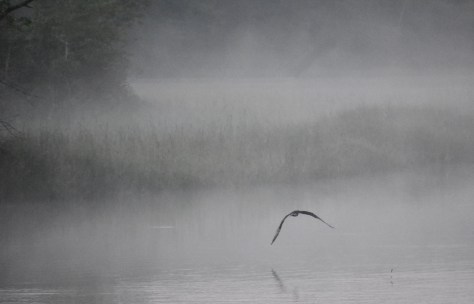
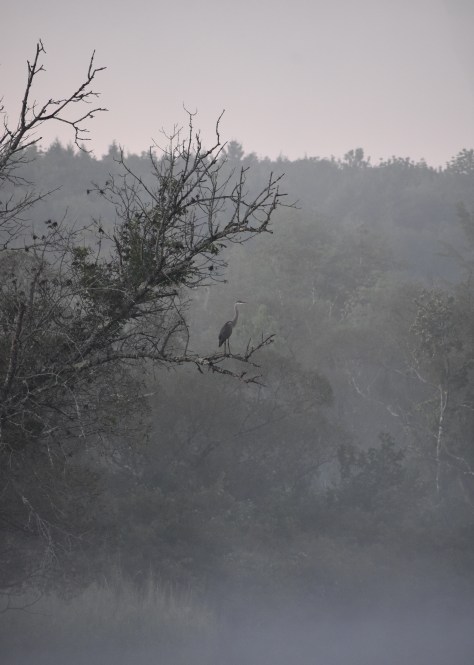
As it flew closer, we could see that it was indeed a great blue heron, one of my favorite birds. It landed briefly on a nearby water plane, then flew off again. I tracked its path through my lens, past an osprey (which I hadn’t even noticed) and on to a perch in a tree along the river’s edge.  Roger and I stood quietly and watched the two birds for long minutes.

Eventually, both osprey and heron flew off. The sun rose higher, lit the mist and gilded the edge of the dock. A small flock of cedar waxwings flittered and flew through the metal lattice of the bridge. Small fish jumped and flashed silver in the river.

I stood and watched it all, fully appreciating the generosity of the morning.

DSC_0176 (1).jpg

DSC_0197.jpg

DSC_0210.jpg

DSC_0250

A Box, A Life, Some Mysteries…

11454297503_e27946e4ff_h

Squatting on the concrete floor amidst the books, toys and odds and ends at our local Recycling Barn this weekend, I saw a fairly large cardboard box filled with small books. Curious, I reached over and pulled one out. It was a 2000 date book.  I pulled out another book. It was another small date book, this one dated 1987. I shuffled through the box, lifting out book after book. 2010, 1990, 1986…1941!

 “Kurt, look!” I said, calling to my husband, “This box is filled with journals!” 

He walked over to join me and I handed him a journal. He riffled through the pages, then handed it back to me. Always the historian, he asked, “How far back do they go? Are there any from the 40s? I wonder if they say anything about the war.”

I dug through the box and pulled out a few of the older journals and handed them to him. We paged through, reading a few entries aloud to each other. Kurt’s speedy skim through 1943 found no references to the war.

There’s not much in here,” he said.

We kept looking. The writing was difficult to decipher at times, but a quick glance revealed that most of the information didn’t seem to be too personal. Each date had a comment about the weather and sometimes a few odds and ends notes about working, appointments, or outings.

I was fascinated by the diaries and had so many questions. Who wrote and kept all of these and how did they end up here? Based on the dates, it seemed safe to assume that the author had died or become incapacitated, but who decided to discard the journals? And at the Recycling Barn?  I was trying not to judge, but it felt a bit callous. While I could understand that the journals were no longer wanted, it seemed like there should have been a more thoughtful resting place for them. Even burning them would seem more respectful.

After a few minutes, I gathered up the journals we had pulled out and returned them to the box.

“I have to take these home,” I announced.

“All of them?” Kurt asked. “Aren’t we trying to get rid of things?”

“All of them,” I insisted, standing up and hefting the box into my arms. “There’s a whole life in this box! And besides,” I continued, “I can always bring them back next weekend.” 

Later that night, I emptied the box onto my family room floor and began to organize, sorting the diaries by year.

67489756_396606860964305_2954363378484641792_n (1).jpg

not quite done sorting!

There were 86 of them, ranging from 1923 to 2013. Most of them were labeled diary or diary/memos. Some years had two diaries, while one year had 3. I didn’t know where to begin and started leafing through random books. Part of me felt guilty –intrusive. Who was I to read another person’s journals even if they seemed impersonal? Yet, another part of me felt that reading them was almost paying homage to the author and recognizing the life these small diaries represented. 

I soon discovered that, although most of the journals were written by one woman, there were several written by another woman. Also, while most days were primarily filled with everyday details, those entries were occasionally juxtaposed with startling news, personal tragedies, and world events.

I’ve barely begun to examine the journals, but my mind keeps returning to them over and over, wiggling thoughts about them like a tongue wiggles a loose tooth. Irresistible, yet slightly uncomfortable. There are so many mysteries within them. Certain names appear and reappear. Who were they? Spouses? Children? Friends? How did the two women know each other? Were they related? Why were their journals mixed together? Why are there so few in the 1970s, but the 60s were almost intact? Am I being nosey and invasive by reading them? And ultimately, what should I do with them?  

Here are a few excerpts:

“August 1943
Wednesday 4 In hospital from 10:30 to 3:30 when Dr. Mixter (?)  told me he found large brain tumor and removed it all and it wasn’t malignant. Thought she would be ok unless unexpected happened. Saw her at 7 pm and she knew me.”

“December 1941

Sunday 7 All to SS or church To Conleys for boughs and cones Japs attacked Hawaiia and declared war

Monday 8 Cool 22˚
President called for and Congress declared war on Japan.
? xmas party at church

Tuesday 9 Cloudy
Bowled at night”


Next to details about temperature and Sunday School, complicated world events and compelling personal experiences have been reduced to a summary sentence or two. Boughs and cones juxtaposed with bombs and war. I guess that’s about right. The mundane daily details of our lives coexist with the tragedies and the triumphs. A life can be encapsulated in a few sentences or paragraphs. Or even sometimes in a box full of diaries.

Update: After responding to Margaret, I realized I hadn’t specified that these journals were in the Swap Shop section of the Recycling Barn. I also hadn’t really thought that through myself. To clarify I didn’t dig through discards for something someone else thought was safely or privately disposed of (that would have felt really invasive!). The Swap Shop is filled with things that still have value, but are not of use to the current owner. The contents range from treasure to trash and are free for the taking. So, the books really weren’t thrown away or destined for recycling, they were offered up like an invitation. Hmmmm….


Reclaiming Summer

11454297503_e27946e4ff_hI think the problem starts when our expectations are too high.

Have you ever heard all about a movie or a book, read rave reviews, heard friends “oooh” and “aaah”, and then you go to see it or you read it? And it’s really very good, but it can’t possibly live up to the hype and those sky-high expectations. You sort of set the bar too high. It’s typically doomed to fail. Or at least fall short.

Well, I’ve started to think that summer can be like that for teachers. We expect extraordinary things from our summers. I, for instance, somehow think that miraculously, I will be able to accomplish every single thing that was pushed to the side, ignored or neglected during the school year–investing time into relationships, self-care, choice reading, household maintenance, exercise, etc and finding time to rest and rejuvenate. Not to mention reading professional books, attending PD, catching up on current kid lit, etc.

I’m in the midst of my much-anticipated summer, and I feel like much of it has already slipped by me and thedaysaregatheringmomentum, hurtlingfasterandfastertowardfall, and, inthemeantime, verylittlehasdisappearedfrommymulti-page “To Do This Summer” listandI’mstillwaitingtoslideintothatsummergroove,butinsteadofrelaxing, I’mstartingtofeelstressedbythepassingdays(OMGit’salmostAugustalready!). Ahhhhhhhhhh!!!!!

I realize that this is slightly ridiculous, but it feels very real. My self talk has also taken on a frantic, and perhaps toxic, tone:

“Time’s a wastin’! Hurry up! Recharge! Rest! Relax! Quickly now! Oh, and don’t forget that list. Clean! Sort! Organize! Or at least clean out your office–which really is a disgrace. That grass isn’t going to mow itself, you know, and the gardens are out of control. Have you read that book yet? What’s the last thing you wrote? Did you retype and synthesize your notes from the June Reading Institute? How about that reading camp? How are you doing with that,huh? Are you relaxed yet?”

Ugh. Even as I write this, I realize how messed up this all is. Or how messed up I am. There are so many things that I “need” to do, that all too often, I end up overwhelmed and do nothing. It feels like summer is my one chance to get it all done–sort of like a “Get Out of Jail Free” card. But time’s passing and I’m not getting much done….What? Wait! Hold on a second! Do you hear that? Listen carefully.  (click below)

Oh, yeah. That feels like the soundtrack of my summer…the sound of summer passing. The constant sense that time is running out and when that timer buzzes, at the end of summer, what will I have to show for this long stretch of carefree golden days? Because, before you know it, that moment will arrive. The buzzer will go off.  And I’ll need to reveal my answer to the the ultimate final jeopardy question: How was your summer?

So today I’m asking myself– How do I want to answer that question at the end of this summer? I still have more than a month of summer break. That’s lots of time. Really it is. (Though I am NOT counting the days and I have asked the librarians to please NOT tell me when my books are due–I don’t want to know what date is only three weeks away!) I’m the one choosing to give that anxiety-inducing music rent-free space in my head. I’m in charge of my self-talk. And when it comes down to it, many, if not most, of my expectations are self-imposed. The “List Police” aren’t going to come knocking on my door come September if there are unfinished items on my, let’s face it, ridiculously impossibly long to-do list. So, what is most important to me this summer? 

I don’t have all the answers yet, but starting today, I’m reclaiming my summer. I’m going to shift my focus and alter that self-talk. I’m going to choose the soundtrack for my summer, and I can guarantee, it’s NOT going to be the Jeopardy challenge song. I’m going to look for the fun in the seeming drudgery (Thanks, humbleswede!) and make a conscious decision to plan some summer fun and to set thoughtful goals and priorities for myself (Thanks, cmargocs!). I’m going to revise that “To Do” list into something more reasonable and become an active agent in creating a really nice summer for myself. I’m not aiming for a bestseller or a blockbuster, more like a feel good beach read. That feels pretty do-able.

In the meantime, I’m still considering my new summer theme song. Any suggestions?


An Unexpected Gift of Poetry

11454297503_e27946e4ff_h

One of my favorite activities at the end of the school year is our poetry jam. We invite families to come in to the classroom, listen to poetry that students have written, and then create poetry together at a variety of centers. We inevitably have a great turnout, and the room is a happy hum of poetry celebration.

This year, the grandfather of one of my students stood by the doorway, a bulky, silent presence. I hadn’t met him before, but his granddaughter had mentioned he’d be coming. He’d slipped into the room right before the students read their poetry, and now remained standing (poised for quick exit?), while she was busy buzzing around the room without him, working with other students and parents. He seemed content where he was, watching the activity, but I suspected that he, like so many adults, was probably uncomfortable with poems and poetry writing. He struck me as the quintessential Mainer–hard-working, somewhat taciturn, with deep ties to the land and community about him. Quiet and strong. 

After glancing about the room to ensure that everyone else was happily occupied, I walked over to introduce myself to him.

We exchanged names and a few pleasantries, and then I asked, “Would you like to write a poem?”

“No,” he replied slowly. Almost thoughtfully.

“Well, have you ever written poetry before?” I asked, in full ambassador mode.

“Yes,” he said. “After I came back from the war.”

Then his voice shifted to a sort of dreamy cadence….”I wrote about lying on the grass under a big oak tree…looking up through the green leaves and branches above me… I wrote about wondering how many birds have nested in this tree…How many animals have made their home in its branches? …And how many children have played in those same branches? …And I hoped my own children and eventually my grandchildren would climb in this tree. …And then, I wondered, after I died, … how long would this tree live… and still provide a home and comfort.”

“Oh,” I said, after a brief moment in which I recalibrated my initial impressions, “that was lovely.”

He told me then about some of his experiences during his service: He was shot in the head, shoulder, thigh and ankle. To this day, it’s still uncomfortable for him to sit, especially in hard chairs intended for much smaller individuals, which is why he was standing.  

Then, at one point, his voice changed again, slowed and deepened, and he said,
I heard the thunder,
then knew it was gunfire.
I heard the screams,
then night fell.
When morning came,
I woke
and wondered
why I had survived.”

Clearly, these words were deeply etched within him. Their power echoed within me. After a moment, I blinked and cleared my throat.

“You’re a wonderful poet, ” I finally said. “Have you shared your poems with your granddaughter or with anyone else in your family?”

“No,” he said. Then he elaborated, in true Maine fashion, “I’ve been working.”

We talked for quite some time, about his school experiences (not positive), his work (long and hard), his family (much beloved). Later in the conversation, he told me that he had shared some of his writing with a veteran’s organization.

Eventually, I realized I’d totally abandoned my classroom responsibilities. I thanked him for coming and for sharing his words with me, and told him how much I’d enjoyed our conversation. Reluctantly, I wandered away to circulate amongst the parents and children, my mind still lingering on our conversation. On the inaccuracies of first impressions. On war. On poetry. 

Two days later, on the last day of school, his granddaughter handed me an envelope. In it her grandfather had enclosed some of his writing. It was about time and change and family. It was beautiful and thoughtful. Once again, I was deeply moved by this unexpected poet and his unexpected gift.

A Long Flight

11454297503_e27946e4ff_hThe end of school came in with a typical whirlwind of activity and a few delightful-but-tiring extras thrown in–an accumulation of a couple of weeks of nonstop activity and lots of people. I packed up my classroom on Friday and limped out of the school year. On Sunday, I took off for NYC and a wonderful, intense week of learning at Teacher’s College Summer Reading Institute.

By the end of the week, I was a limp dishrag, ready to hoist the white flag (and to mix a few metaphors along the way), and in search of solitary confinement. But it was time to head to Ohio for a visit with family and friends. 

I hate flying, and typically dread the entire experience, but as I boarded the plane, it occurred to me that this flight was going to be my last chance for solitude and relative inactivity for the next 4 or 5 days.

“It might even be nice!” I thought, looking forward to peace, quiet and some solid reading time.

Then my seat mate arrived.

She was a lovely, young woman, excited to be heading back from a trip to Germany to visit her parents and looking forward to her reunion with her boyfriend, and their new apartment, and the upcoming trip with his family, which she’d promised them a year ago that she would go on and it meant she had to leave Germany early, but…

Ding! 

She paused to glance down at an incoming text.

“Oh, my family just went to the vineyards without me! Why would they do that after I left!?”

She then burbled on at greater length about her family, her boyfriend, her recent trip, her upcoming trip. She was lovely and sweet, but oy!

She finally paused and asked me, “What do you do?”

“I’m a teacher.”

“Oh, what grade?” she asked.

“Fourth,” I replied.

She turned her body fully toward me, her face alight.

“Oh! My fourth grade teacher saved my life!” she exclaimed. Then she went on and on… about how she thought she’d wanted to be a teacher, and about an experience she’d had working in a classroom when she was in school in England (with a long detour to explain why she’d attended middle school and high school in England) and how wonderful it was but it just wasn’t for her, but the kids made her this wonderful book and she still has it and it was wonderful ….

Then she repeated, “I just loved my fourth grade teacher! She saved my life! Really, she did! She was the first person to bring my attention difficulties to my parents’ attention.” (Which, to be honest, made me wonder how much attention her parents had been paying. I also heroically restrained myself from suggesting that her prior teachers had probably noticed something as well.)

She continued, “We loved her. And she loved us.” She paused dramatically, then said, “She loved us so much that she taught us the next year, too!”

uh huh

Eventually, after I had a pretty good picture of the past year or so of her life, with some childhood details sketched in as well, she trailed off and we began taxiing down the runway.

Taking-off is the hardest part of any flight for me. My go-to strategy is to bury myself in a puzzle book of sorts, typically word games. So, I buried myself in my crossword, trying to pretend I wasn’t on a plane (my go-to strategy). I entered my zone of intense concentration.

Midway through our ascent, a voice penetrated my carefully constructed zone. I ripped my focus from my puzzle book and looked around.

“Excuse me. Excuse me…”

I turned toward my seat mate. Yes, she was talking to me.

“I’m sorry to bother you, but I thought since you’re a teacher, you’d  have seen a lot of this and know.” She pushed her finger into her right eyelid and bent closer to me.

“Do you think I have pink eye?” she asked.

I stared at her, slightly bemused. “What?”

“Do you think I have pink eye?” she repeated, jabbing her finger toward her eye again.

Finally, I replied, noncommittally, “Well, your eye lid is slightly red.”

“I know!” she enthused. “It’s been bothering me all day and it feels funny. So I was wondering if you think it might be pink eye.” She looked at me expectantly, leaning closer.

I stared back at her.

“No,” I finally said slowly and decisively, still struggling to make sense of the moment, “it is not pink eye.”

“Oh, phew!” she said, exhaling, and leaning back into her seat, looking mightily relieved.

Phew?! Phew?! Like I’m the authority and this potential problem is now solved?

I turned back to my puzzle book and went back to pretending I wasn’t on a plane, hoping that she really didn’t have pink eye.

It was going to be a long flight.