Question


74707-poetry-friday-logoAfter a medical emergency with my husband late last week, things have calmed down a bit, but the questions remain, as does the elevated stress level. Seeking periodic escape from the latter, I’ve spent some time lost in my computer, reading/answering e-mails, avoiding news, and liberally dosing myself with poetry, nature photography and cat videos. (And look, did you see what I just did there? With the cat videos? That was sort of a joke (even if not totally untrue). Surely that means things are on an upswing!)

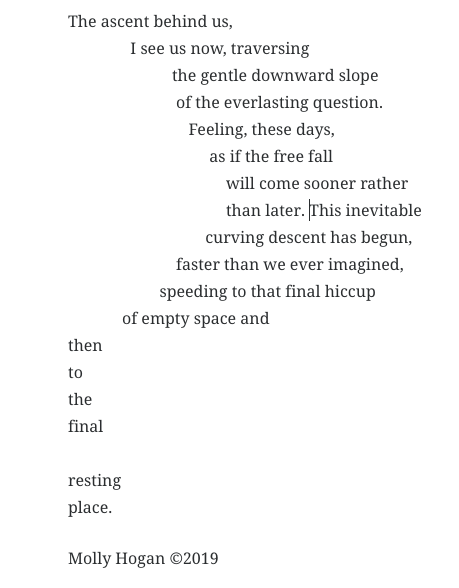
At any rate, I wasn’t sure I’d be participating in PF this week. My focus has been shot, and my writing has been erratic. Sadly, I didn’t get a chance to work on a tree poem to participate with Christie’s theme. Then, looking back through my queue of unattended e-mails, I read Jane Yolen’s daily poem from August 11th. It was a response to David L. Harrison’s word prompt for August: “Question.” Between the medical situation and being in my early 50s, I’ve certainly been feeling questions swirling lately and this was my response to that prompt. (WordPress wasn’t happy with my formatting attempts, so I’ve had to go with screen shots.)

Screen Shot 2019-08-15 at 6.02.35 PM.png

Screen Shot 2019-08-15 at 5.55.16 PM.png

After rereading it, I realize this poem might sound a bit…dark…but it’s just what happened when I sat down to write. 

This week’s Poetry Friday Roundup is hosted by tree-loving Christie Wyman at her blog, Wondering and Wandering.  Make sure to stop by and see what sort of tree-inspired poetry is gathering there.

Navigating a New Course

11454297503_e27946e4ff_h

Twenty minutes after I leave home, I pull onto the access road to the hospital. Thinking how routine this already feels. Thinking I don’t want this to be a new normal. I navigate without conscious thought, easily finding my way to patient visitor parking. I park and walk toward the building, eager to see you, wondering how your night was. The doors open automatically as I approach, and I enter, turning left toward the stairs that will take me up to your room.

I’ve been up and down these stairs dozens of times in the past two days. Going to the bathroom. Trying to get cell phone reception. Calling people to give updates. Running to the car to grab something. Bringing your cell phone down so that texts will come through. Moving just to move.

At the bottom of the stairs this morning, I stop and look up, feeling my anxiety ratchet up. How will you be? How was your night? Will we get any answers today? Will they be reassuring or not? What happens next?

The steps stretch up before me. I take a deep breath and mount them slowly.

One.

Two.

Three.

The wall along the stairs is decorated with large paintings, primarily Maine land- and seascapes. I haven’t looked at them closely, but in my many trips up and down, one in particular has drawn my eye again and again. Perhaps it’s because of its location–at the top of the stairs. Or perhaps because of its subject–a single sailboat underway in the midst of a vast expanse of ocean. The waters sometimes appear calm to me, and sometimes seem more turbulent. It must depend on the angle. Always, though, the sailboat looks the same– small and so vulnerable in the midst of so much water. No land in sight.

I climb the stairs slowly, my eyes lingering on that painting. On that small boat. On the blue seas surrounding it. I think of this journey we’re on, and wonder where we’re going. What will our destination be?

Finally, I reach the landing.

It feels selfish and cowardly, but I stand still for just a moment. Just one. I want to exist in this brief space of not knowing anything more. Just for a minute. One, long minute when nothing changes. Even though this minute is fraught, it could be easier than the next one. Or the next one could be easier, I remind myself. Though that’s just not the way I think. I’m so scared.

I take the moment. Stretch it out for a bit longer. Then I step forward, turn the corner, and walk down the hallway to your room.


The Poetry Friday Roundup is Here!

74707-poetry-friday-logoWelcome to this week’s Poetry Friday Roundup! I was so excited to be hosting this week for  many reasons, but not least because I knew immediately what to title this blog post. Phew!

Titles are so important, but they give me so much trouble.  Far too often I hem and haw, and then finally choose a title simply to have it done. On rare occasions, a title comes to me immediately, but I can’t stress enough how rare that is. Usually, it’s a difficult process and results in a title that, at best, feels adequate. At worst, the process makes me circle round and round, tear my hair out, agonize loudly and at length, and question my writing skills. It’s an ugly process. Sigh.

A few weeks ago, not long after yet another title tussle, a Poetry Foundation Poem of the Day post popped up in my Inbox. The poem for that day was titled, “Lost in the Milky Way.” That’s a great title, I thought. Suddenly, it occurred to me that I could use the title like a found line. Inspired by that title, I could write a poem, and then I could even compare it to the one the poet wrote. The hard part was not looking at the original poem until mine was written. The wonderful, freeing part was knowing that I already had a title for my poem!

Now, I thought that I was very clever. I’d already written most of this post and had my plan in place. Then, I read Margaret Simon’s PF post two weeks ago. Rats! Apparently, my idea was not as innovative as I had thought! lol She noted that Austin Kleon shares the title-stealing idea in “Steal Like An Artist” and then went on to share a beautiful poem of her own based on a title stolen from a painting. Oh, well. I decided to go with my plan anyway. Maybe I’m stubborn, maybe I’d already invested too much energy, or maybe I just couldn’t face having to create a title!

At any rate, here’s my poem, based on a stolen title:

Lost in the Milky Way

To lose oneself in the Milky Way
first one must find it.

“Is that it?” I asked
that first night, so long ago.
“That smudgy streak?”

“That’s our galaxy!”
Your words tumbled out,
intense and eager.
“Made of millions–no, billions
of stars
            and planets
                               and solar systems!
It’s a barred spiral of light!”

You spouted facts and figures,
gesturing with one hand
while the other held mine.
My head swirled
with light years and
numbers with zero
                                 after zero
                                                 after zero.

Standing beside you now,
gazing into space,
my hand slips into yours.
I ground myself
in this one moment
in space and time,
while you continue to sing
your love song to the universe,
lost in the Milky Way.

Molly Hogan ©2019

Once my poem was written, I was eager to go back to the Poetry Foundation e-mail and check out the original poem with the inspiring title. The first thing that startled me was the poet’s name, which hadn’t been visible in the e-mail title. Linda Hogan! Go figure! (Thanks, Linda, for a great title! )Then, I read her poem.

Lost in the Milky Way

Some of us are like trees that grow with a spiral grain
as if prepared for the path of  the spirit’s journey
to the world of all souls.
It is not an easy path.
A dog stands at the opening constellation
past the great helping hand.
….. (click the title to read the whole poem.)
I’ve read this poem over and over again. It’s rich and layered and pretty wonderful. Very different from my poem. Isn’t it fascinating how the same title can lead in totally different directions?
So, if you’re interested in playing along, here are a few recent titles (with links to the original poems) that might be fun to play with–Please note, I haven’t read any of these poems, so I don’t know what you’ll find when you click on the links. I simply found the titles evocative.
Dear Echo
Also, next week Christie Wyman at Wondering and Wandering is hosting the Roundup. She’s thrown out an optional poetry theme of trees. Maybe you can steal a title to go along with that!
Lee  Bennett Hopkins

Photograph by Charles J Egita Photo

Note: I have just read the terribly sad news that Lee Bennett Hopkins died today. On the home page of his blog, he says: “Give children poetry. It is one of the best gifts you can give them…a gift to last a lifetime.” Thank you so much, Lee, for sharing your poetic gifts with all of us. You will be missed.
Image result for
Please click below to add your link for this week’s Poetry Friday Roundup.

Update: I apologize if I’ve been late approving any posts, or have missed approving any, and for not getting around to read and comment on posts. I’ve been unexpectedly caught up in a medical emergency. Thanks for understanding, and I will do the best I can when I can.

Poetry Friday: Definitos

74707-poetry-friday-logo


Last month, Heidi Mordhorst posed our Sunday writing critique group the challenge of writing a definito, a fabulous poetry form that she created and defined many moons ago. In short, Heidi describes the definito as “a free verse poem of 8-12 lines (aimed at readers 8-12 years old) that highlights wordplay as it demonstrates the meaning of a less common word, which always ends the poem.” I soon discovered that, even though I came up with word after word to use, the poems are much more challenging to write than I expected. Here are three of mine.

solitary

when there’s only
one
not two or three
existing
alone
on
its
own
solitary

©Molly Hogan, 2019

resilient.jpg

resilient

When challenges rise
like a flooding river
hold tight in the current
bend with the flow
Be strong
Be tough
Don’t let go…
Be resilient

©Molly Hogan, 2019

And then, just for kicks… and without a photo—

Regurgitate

Upchuck, throw up
heave, hurl, spew

Tossing cookies
sick with flu

What’s a queasy
kid to do?

Nauseous, achy
don’t feel great?

Grab a bucket!
DO NOT WAIT!

You’re going to…
regurgitate

©Molly Hogan, 2019

This week, Heidi‘s highlighting definitos as she hosts Poetry Friday at her blog, My Juicy Little Universe. Make sure to stop by to read more about the evolution of the form and to see some examples. Keep your eyes open while you wander through the Roundup, as  there will be plenty more definitos around! Then, consider trying your hand at writing one, but be forewarned: Writing these is kind of addictive! 


A Box, A Life, Some Mysteries…

11454297503_e27946e4ff_h

Squatting on the concrete floor amidst the books, toys and odds and ends at our local Recycling Barn this weekend, I saw a fairly large cardboard box filled with small books. Curious, I reached over and pulled one out. It was a 2000 date book.  I pulled out another book. It was another small date book, this one dated 1987. I shuffled through the box, lifting out book after book. 2010, 1990, 1986…1941!

 “Kurt, look!” I said, calling to my husband, “This box is filled with journals!” 

He walked over to join me and I handed him a journal. He riffled through the pages, then handed it back to me. Always the historian, he asked, “How far back do they go? Are there any from the 40s? I wonder if they say anything about the war.”

I dug through the box and pulled out a few of the older journals and handed them to him. We paged through, reading a few entries aloud to each other. Kurt’s speedy skim through 1943 found no references to the war.

There’s not much in here,” he said.

We kept looking. The writing was difficult to decipher at times, but a quick glance revealed that most of the information didn’t seem to be too personal. Each date had a comment about the weather and sometimes a few odds and ends notes about working, appointments, or outings.

I was fascinated by the diaries and had so many questions. Who wrote and kept all of these and how did they end up here? Based on the dates, it seemed safe to assume that the author had died or become incapacitated, but who decided to discard the journals? And at the Recycling Barn?  I was trying not to judge, but it felt a bit callous. While I could understand that the journals were no longer wanted, it seemed like there should have been a more thoughtful resting place for them. Even burning them would seem more respectful.

After a few minutes, I gathered up the journals we had pulled out and returned them to the box.

“I have to take these home,” I announced.

“All of them?” Kurt asked. “Aren’t we trying to get rid of things?”

“All of them,” I insisted, standing up and hefting the box into my arms. “There’s a whole life in this box! And besides,” I continued, “I can always bring them back next weekend.” 

Later that night, I emptied the box onto my family room floor and began to organize, sorting the diaries by year.

67489756_396606860964305_2954363378484641792_n (1).jpg

not quite done sorting!

There were 86 of them, ranging from 1923 to 2013. Most of them were labeled diary or diary/memos. Some years had two diaries, while one year had 3. I didn’t know where to begin and started leafing through random books. Part of me felt guilty –intrusive. Who was I to read another person’s journals even if they seemed impersonal? Yet, another part of me felt that reading them was almost paying homage to the author and recognizing the life these small diaries represented. 

I soon discovered that, although most of the journals were written by one woman, there were several written by another woman. Also, while most days were primarily filled with everyday details, those entries were occasionally juxtaposed with startling news, personal tragedies, and world events.

I’ve barely begun to examine the journals, but my mind keeps returning to them over and over, wiggling thoughts about them like a tongue wiggles a loose tooth. Irresistible, yet slightly uncomfortable. There are so many mysteries within them. Certain names appear and reappear. Who were they? Spouses? Children? Friends? How did the two women know each other? Were they related? Why were their journals mixed together? Why are there so few in the 1970s, but the 60s were almost intact? Am I being nosey and invasive by reading them? And ultimately, what should I do with them?  

Here are a few excerpts:

“August 1943
Wednesday 4 In hospital from 10:30 to 3:30 when Dr. Mixter (?)  told me he found large brain tumor and removed it all and it wasn’t malignant. Thought she would be ok unless unexpected happened. Saw her at 7 pm and she knew me.”

“December 1941

Sunday 7 All to SS or church To Conleys for boughs and cones Japs attacked Hawaiia and declared war

Monday 8 Cool 22˚
President called for and Congress declared war on Japan.
? xmas party at church

Tuesday 9 Cloudy
Bowled at night”


Next to details about temperature and Sunday School, complicated world events and compelling personal experiences have been reduced to a summary sentence or two. Boughs and cones juxtaposed with bombs and war. I guess that’s about right. The mundane daily details of our lives coexist with the tragedies and the triumphs. A life can be encapsulated in a few sentences or paragraphs. Or even sometimes in a box full of diaries.

Update: After responding to Margaret, I realized I hadn’t specified that these journals were in the Swap Shop section of the Recycling Barn. I also hadn’t really thought that through myself. To clarify I didn’t dig through discards for something someone else thought was safely or privately disposed of (that would have felt really invasive!). The Swap Shop is filled with things that still have value, but are not of use to the current owner. The contents range from treasure to trash and are free for the taking. So, the books really weren’t thrown away or destined for recycling, they were offered up like an invitation. Hmmmm….
 

Happiness is…

74707-poetry-friday-logo

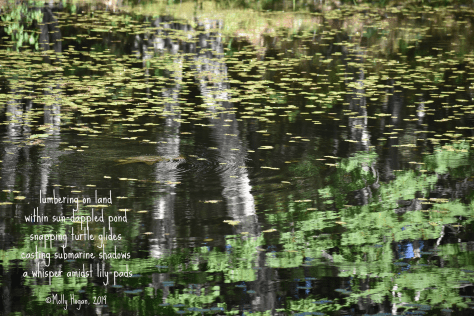
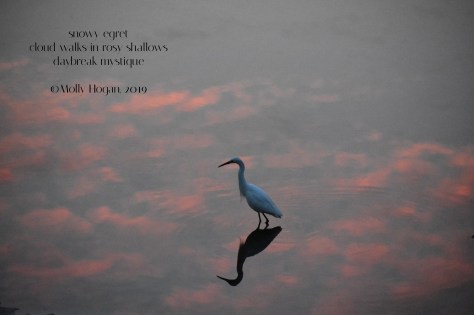
Happiness is combining my love of photography, nature and words. These days, I’m feeling so thankful for the beauty that surrounds me and for the respite it offers.  Here’s hoping that your summer days are also filled with natural wonders and time to appreciate them.

turtle final

lumbering* on land
within sun-dappled pond
snapping turtle glides
casting submarine shadows
a whisper amidst lily pads

©Molly Hogan, 2019

dragonfly

cloud walking

snowy egret
cloud walks in rosy shallows
daybreak mystique

©Molly Hogan, 2019

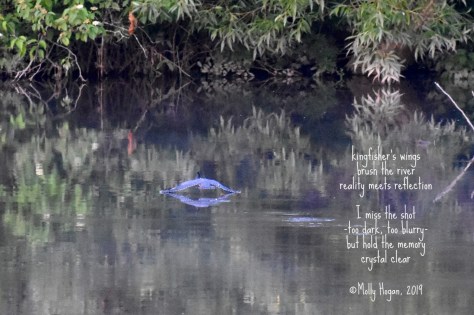
kingfisher

kingfisher’s wings
brush the river
reality meets reflection

I miss the shot
-too dark, too blurry-
but hold the memory
crystal clear

©Molly Hogan, 2019

Make sure to stop by Margaret Simon’s blog Reflections on the Teche today. She’s hosting this week’s Poetry Friday Roundup with a beautiful, poignant poem, crafted from a stolen title.

*Thanks to Catherine Flynn for this word choice!

Reclaiming Summer

11454297503_e27946e4ff_hI think the problem starts when our expectations are too high.

Have you ever heard all about a movie or a book, read rave reviews, heard friends “oooh” and “aaah”, and then you go to see it or you read it? And it’s really very good, but it can’t possibly live up to the hype and those sky-high expectations. You sort of set the bar too high. It’s typically doomed to fail. Or at least fall short.

Well, I’ve started to think that summer can be like that for teachers. We expect extraordinary things from our summers. I, for instance, somehow think that miraculously, I will be able to accomplish every single thing that was pushed to the side, ignored or neglected during the school year–investing time into relationships, self-care, choice reading, household maintenance, exercise, etc and finding time to rest and rejuvenate. Not to mention reading professional books, attending PD, catching up on current kid lit, etc.

I’m in the midst of my much-anticipated summer, and I feel like much of it has already slipped by me and thedaysaregatheringmomentum, hurtlingfasterandfastertowardfall, and, inthemeantime, verylittlehasdisappearedfrommymulti-page “To Do This Summer” listandI’mstillwaitingtoslideintothatsummergroove,butinsteadofrelaxing, I’mstartingtofeelstressedbythepassingdays(OMGit’salmostAugustalready!). Ahhhhhhhhhh!!!!!

I realize that this is slightly ridiculous, but it feels very real. My self talk has also taken on a frantic, and perhaps toxic, tone:

“Time’s a wastin’! Hurry up! Recharge! Rest! Relax! Quickly now! Oh, and don’t forget that list. Clean! Sort! Organize! Or at least clean out your office–which really is a disgrace. That grass isn’t going to mow itself, you know, and the gardens are out of control. Have you read that book yet? What’s the last thing you wrote? Did you retype and synthesize your notes from the June Reading Institute? How about that reading camp? How are you doing with that,huh? Are you relaxed yet?”

Ugh. Even as I write this, I realize how messed up this all is. Or how messed up I am. There are so many things that I “need” to do, that all too often, I end up overwhelmed and do nothing. It feels like summer is my one chance to get it all done–sort of like a “Get Out of Jail Free” card. But time’s passing and I’m not getting much done….What? Wait! Hold on a second! Do you hear that? Listen carefully.  (click below)

Oh, yeah. That feels like the soundtrack of my summer…the sound of summer passing. The constant sense that time is running out and when that timer buzzes, at the end of summer, what will I have to show for this long stretch of carefree golden days? Because, before you know it, that moment will arrive. The buzzer will go off.  And I’ll need to reveal my answer to the the ultimate final jeopardy question: How was your summer?

So today I’m asking myself– How do I want to answer that question at the end of this summer? I still have more than a month of summer break. That’s lots of time. Really it is. (Though I am NOT counting the days and I have asked the librarians to please NOT tell me when my books are due–I don’t want to know what date is only three weeks away!) I’m the one choosing to give that anxiety-inducing music rent-free space in my head. I’m in charge of my self-talk. And when it comes down to it, many, if not most, of my expectations are self-imposed. The “List Police” aren’t going to come knocking on my door come September if there are unfinished items on my, let’s face it, ridiculously impossibly long to-do list. So, what is most important to me this summer? 

I don’t have all the answers yet, but starting today, I’m reclaiming my summer. I’m going to shift my focus and alter that self-talk. I’m going to choose the soundtrack for my summer, and I can guarantee, it’s NOT going to be the Jeopardy challenge song. I’m going to look for the fun in the seeming drudgery (Thanks, humbleswede!) and make a conscious decision to plan some summer fun and to set thoughtful goals and priorities for myself (Thanks, cmargocs!). I’m going to revise that “To Do” list into something more reasonable and become an active agent in creating a really nice summer for myself. I’m not aiming for a bestseller or a blockbuster, more like a feel good beach read. That feels pretty do-able.

In the meantime, I’m still considering my new summer theme song. Any suggestions?


Shifting Focus

74707-poetry-friday-logo

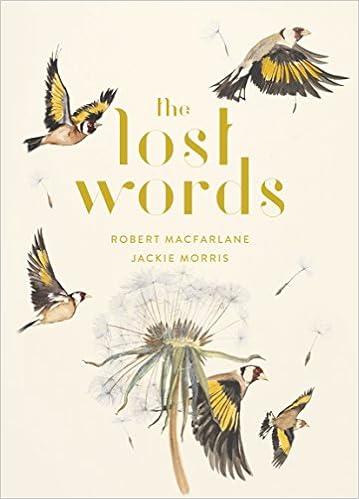
Image result for lost words

I purchased “Lost Words” by Robert G. Macfarlane quite some time ago after someone shared it here at PF. (Sorry! I can’t remember who. Update: It was Christie Wyman with this post.)  Wow! What a gorgeous book–both the poems and the illustrations.

Then, in June, Mary Lee Hahn tweeted that there are songs to go along with the poems. What!? I fell in love with this one and listened to it over and over and over again. It’s hauntingly beautiful.

“Enter the wild with care, my love, and speak the things you see.  Let new names take and root and thrive and grow.” Sigh…..beautiful….

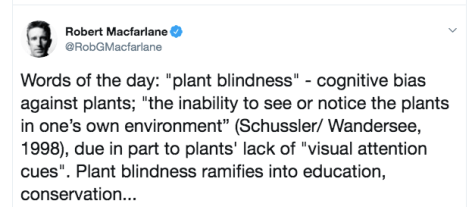
I started following Macfarlane on twitter. Browsing through recent tweets, I found one in which he shared the term “plant blindness”.

Screen Shot 2019-07-18 at 6.42.54 AM.png

What a fascinating idea! In the thread of comments, someone shared a link to the original article (here) and a man named James Lomax also responded. He said he’d once walked with a wildflower expert who’d said, “The world comes into focus when you can identify the flowers.” I loved that idea. It helped me to put words to the deep pleasure I get from naming the plants and flowers that surround me when I’m out and about. Having read Tricia Stohr-Hunt’s PF clever triolet earlier this month, I was inspired to revisit that form with this idea in mind. Of course, she made it look so easy! ha! I’d forgotten how tricky these are. This one’s been more than a bit squirmy and hasn’t fully settled down yet. Perhaps it’s just a bit out of focus…

Shifting Focus

Naming plants and flowers
shifts the world into focus
In gilded fields or dappled bowers
naming plants and flowers
uplifts and empowers
Trillium, wintergreen, wild crocus
Naming plants and flowers
shifts the world into focus

Molly Hogan ©2019 (draft)

Check out this week’s bouquet of poetry (and a really cute puppy!) at the Poetry Friday Roundup at Carol’s Corner.

An Unexpected Gift of Poetry

11454297503_e27946e4ff_h

One of my favorite activities at the end of the school year is our poetry jam. We invite families to come in to the classroom, listen to poetry that students have written, and then create poetry together at a variety of centers. We inevitably have a great turnout, and the room is a happy hum of poetry celebration.

This year, the grandfather of one of my students stood by the doorway, a bulky, silent presence. I hadn’t met him before, but his granddaughter had mentioned he’d be coming. He’d slipped into the room right before the students read their poetry, and now remained standing (poised for quick exit?), while she was busy buzzing around the room without him, working with other students and parents. He seemed content where he was, watching the activity, but I suspected that he, like so many adults, was probably uncomfortable with poems and poetry writing. He struck me as the quintessential Mainer–hard-working, somewhat taciturn, with deep ties to the land and community about him. Quiet and strong. 

After glancing about the room to ensure that everyone else was happily occupied, I walked over to introduce myself to him.

We exchanged names and a few pleasantries, and then I asked, “Would you like to write a poem?”

“No,” he replied slowly. Almost thoughtfully.

“Well, have you ever written poetry before?” I asked, in full ambassador mode.

“Yes,” he said. “After I came back from the war.”

Then his voice shifted to a sort of dreamy cadence….”I wrote about lying on the grass under a big oak tree…looking up through the green leaves and branches above me… I wrote about wondering how many birds have nested in this tree…How many animals have made their home in its branches? …And how many children have played in those same branches? …And I hoped my own children and eventually my grandchildren would climb in this tree. …And then, I wondered, after I died, … how long would this tree live… and still provide a home and comfort.”

“Oh,” I said, after a brief moment in which I recalibrated my initial impressions, “that was lovely.”

He told me then about some of his experiences during his service: He was shot in the head, shoulder, thigh and ankle. To this day, it’s still uncomfortable for him to sit, especially in hard chairs intended for much smaller individuals, which is why he was standing.  

Then, at one point, his voice changed again, slowed and deepened, and he said,
I heard the thunder,
then knew it was gunfire.
I heard the screams,
then night fell.
When morning came,
I woke
and wondered
why I had survived.”

Clearly, these words were deeply etched within him. Their power echoed within me. After a moment, I blinked and cleared my throat.

“You’re a wonderful poet, ” I finally said. “Have you shared your poems with your granddaughter or with anyone else in your family?”

“No,” he said. Then he elaborated, in true Maine fashion, “I’ve been working.”

We talked for quite some time, about his school experiences (not positive), his work (long and hard), his family (much beloved). Later in the conversation, he told me that he had shared some of his writing with a veteran’s organization.

Eventually, I realized I’d totally abandoned my classroom responsibilities. I thanked him for coming and for sharing his words with me, and told him how much I’d enjoyed our conversation. Reluctantly, I wandered away to circulate amongst the parents and children, my mind still lingering on our conversation. On the inaccuracies of first impressions. On war. On poetry. 

Two days later, on the last day of school, his granddaughter handed me an envelope. In it her grandfather had enclosed some of his writing. It was about time and change and family. It was beautiful and thoughtful. Once again, I was deeply moved by this unexpected poet and his unexpected gift.