An apology poem

poetry+friday+button-e1341309970195After writing a rather unfriendly poem about blue jays recently (here), I did some research and realized that I may have misjudged them.  I thought it might be fun to write an apology poem, but I needed to explore a few examples first. So, I looked to the ultimate mentor apology poem:

This Is Just to Say.
I have eaten 
the plums
that were in
the icebox

and which 
you were probably
saving
for breakfast

Forgive me
they were delicious
so sweet
and so cold

–William Carlos Williams

And can we just sit with that sweet perfection for a moment? Ahhhhh…

Next, I read through some of the poems in the wonderful Joyce Sidman’s This Is Just to Say- Poems of Apology and Forgiveness. Due to some time constraints, I wanted to skim through, but I found myself pulled in headfirst, going back to the beginning and reading each wonderful poem, the apologies and then the responses, again and again. What a treat! The characters shine through their poems and it’s amazing how much comes through about their struggles, their emotional truths, and their connections. I can’t wait to share these poems with my students.

One of these poems, Fashion Sense , begins with the line “I am so sorry for my rude words,” and later continues
“all the next day, I wished I could take those words back.
I kept thinking of what you always say to us:
words can help or hurt, the choice is ours.”

Isn’t that last line wonderful? I know I’m going to add it to my repertoire of classroom mantras. While there are so many other poems that moved me (like Secret Message  and I’m Telling You Now), Fashion Sense seemed like the best mentor poem for my type of apology. I lifted the first line from it to begin.

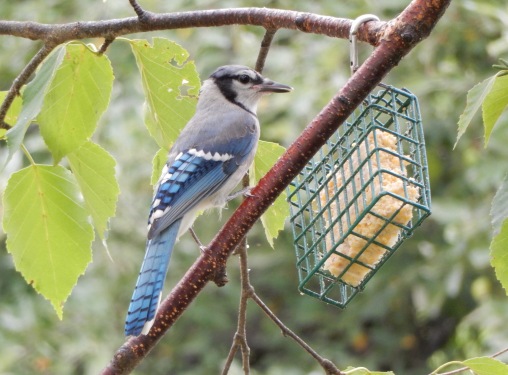
DSCN7307

to the blue jays

I am so sorry for my rude words.
I spoke hastily,
judging you from what I’d heard-
your grating, raucous cries-
and also the rumors that said….
well, you know what they said.
I’m sorry for ignoring your beauty,
your glorious burst of color
in winter’s weary landscape,
for calling you names
and for telling you to go away,
like the bully I said you were.
Forgive me.
I promise now I’ll watch you closer,
let your behavior speak for itself.
I won’t judge all of you
based on one or two bad eggs.
I’ll notice when your crests are up or down
and whether you sneak away
with foraged food to cache.
I’ll imagine your forgotten acorns
sprouting into forests of oak trees.
I’ll admire you,
with your multi-hued blue plumage,
settling like patches of sky
framed in circles of birch leaves.
I still wish you had better manners
and you could tone down the squawking.
But you’re welcome at my feeders.
Forgive me.

Molly Hogan (c) 2016

This week’s Poetry Friday Roundup is hosted by Julieanne at To Read To Write To Be. Head on over to enjoy some more poetry!

Mirrors and Windows

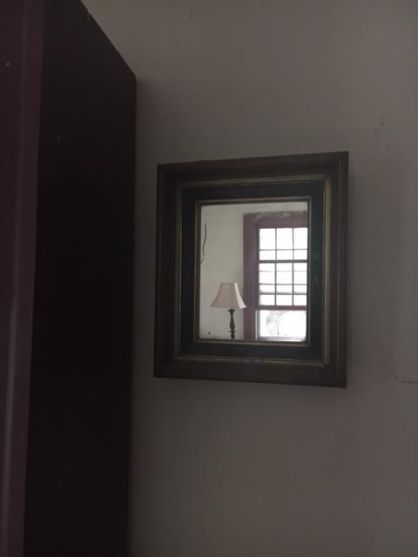
IMG_0538I’ve been thinking a lot about mirrors and windows recently. To be more specific, I’ve been thinking a lot about how the books in our classrooms should serve as both mirrors and windows for our students. I’m not sure who coined these terms or when their use originated and I suspect I’m late to the discussion. Regardless, I’ve given a lot of thought lately to the role of diverse books in my library and to the reasons why deliberate cultivation of a diverse library is important. I’m sharing my evolving thoughts here, hoping for feedback from others who may have insight I am lacking, or alternative viewpoints I may not have considered.

When we select books and put them into the hands of children, we are doing more than teaching them to read. We are, intended or not, sending messages about the world. It is crucial that we offer books that are both windows and mirrors to our students and that we experience these books with them. When books act as mirrors, they offer children the chance to see themselves in a story, in a world they readily understand. These books are a scaffolded step into literacy. Children can relate to protagonists, understand settings and problems and have their worlds validated. Members of majority populations have many, many books that serve as mirrors. Minority students? Not so many. They have far more window books. When books act as windows, they share a view into a different world for students. Within the pages of that book, children can experience a foreign culture and/or setting with protagonists who may look different from them and who inhabit different landscapes. When we hand majority students mirror books over and over, we are limiting them, doing them and society a disservice and missing an opportunity to broaden their horizons.  Is there also an unintended subliminal message– That your world is the only one of value, the only one worthy of portraying in the pages of a book?  When minority students don’t see their world in a book, they may not readily identify with what they are reading and their world is not validated. Their scaffolded step into literacy is missing. Writer Chimamanda Ngozi Adichie spoke eloquently about this in her TED Talk and identified another danger as well.

In her 2009 TED Talk “The Danger of a Single Story”  Chimamanda Ngozi Adichie talks about her childhood in Nigeria  with her literary experiences centered around British and American literature. She talks about writing her first stories about white children with blue eyes who drank ginger beer, ate apples and played in the snow.“What this demonstrates, I think, is how impressionable and vulnerable we are in the face of a story, particularly as children. Because all I had read were books in which characters were foreign, I had become convinced that books by their very nature had to have foreigners in them and had to be about things with which I could not personally identify.” Our book selection in the classroom sends many messages to our students and we need to be keenly aware of them. Later in her speech Ms. Adichie acknowledges another risk, that of providing only one vision or story within a mirror or a window book. “The single story creates stereotypes,and the problem with stereotypes is not that they are untrue, but that they are incomplete. They make one story become the only story.”

So, not only do we need to provide stories rich in diversity, we must ensure that they offer multiple views into different cultures and ways of life. Offering the same window or mirror into the world perpetuates stereotypes–like all those white blue-eyed children drinking ginger beer and playing in the snow. Considering some of my favorite multicultural books  (Those Shoes , The Day of Ahmed’s Secret, Ezra Jack Keat’s books, A Splash of Red: The Life and Art of Horace Pippin ), I realize, with a start, that though they are wonderful, rich books, they offer a limited view of minorities and foreign cultures, one rooted primarily in urban and poor settings. I also realize that within my library, there are few books that offer windows into differences based in  religion, ability, sexuality. Clearly I have some work to do to ensure that my classroom library represents many differences and does not perpetuate any one stereotypical story for my insulated students.

I live and work in rural Maine. Until recently, multicultural issues have felt remote. The student population at our K-8 school is 98-99% Caucasian.  In my classroom I teach my students to empathize with each other, to speak and act respectfully, to persevere, to be friendly even if you can’t be friends. But they are a highly homogenous group. I now recognize that I have missed literacy-based opportunities to help them understand that respect, courtesy and empathy need to stretch across lines of culture, race, religion, etc. I’ve done some work to introduce diverse books to my students, but to be honest, I’m ashamed to say this hasn’t been a priority. In my ignorance I thought these aren’t issues that are relevant to my students right now. They aren’t issues that are in their daily lives. So, I’ve paid lip service to this need and I’m not proud of this. Given recent world events and my growing understanding, I now know that my rural Maine students need these experiences more than others, not less.

At ILA16 Pernille Ripp shared data from a PEW Research Center survey that found that 28% of adults had not read a book in the past 12 months.  She went on to say, “When we talk about creating empathetic human beings and wonder why our world is broken…I think it has something to do with that 28%.” Then she added the zinger. “Our literacy decisions create those adults.”  The responsibilities of being a teacher have never felt weightier.  Yet with that responsibility comes a glimmer of hope. Maybe there is something I can do to light up the dark corners of this world. Perhaps my battlefield is in the classroom and my weapons are books.

So, I look into my own mirror and ask myself, if not now, when? And if not me, who? As a teacher, I can and should provide students with windows to the world around them. (In general, mirror books are readily available for my students.) I have a heightened obligation to put diverse books into my students’ hands–to show them other perspectives, other cultures, and to teach them to value all human life and experience–and to ensure that these window books show multiple views and don’t tell a single story. Because for the most part my students aren’t going to encounter these differences in their daily lives. It’s easy to fear that which is unknown and too often these days we see and hear people using violent and frightening language and suggesting closing the doors (and our hearts and minds) against those who are “other.”

I want to arm my students with the tools they need to thrive in this world and to spread seeds of kindness, not hatred. To seek empathy even when the distance and differences seem overwhelming. To use the tools of literacy to stretch their minds and learn about others. To embrace differences and to recognize that if we focus only on the differences, we miss the opportunities to connect at a more fundamental level. For underneath it all, isn’t a critical outcome of celebrating and exploring multiple worlds and world views the recognition of how similar we all really are?
unnamed


Oh, no!

11454297503_e27946e4ff_h

search“Excuse me, can you tell me where the restrooms are?” I ask the man at the counter.

“Oh, they’re on the third floor in the Children’s Department,” he replies with a smile.

“The third floor?” I repeat in dismay, jaw dropping. Oh, dear. I should NOT have waited so long. I had met a colleague in the coffee shop on the ground floor of the LL Bean store to plan a PD session. I’d ignored my need to use the bathroom until we finished working. Considering I’d spent the morning consuming vast quantities of coffee, this wasn’t a grand plan. I had just assumed there’d be a bathroom nearby. Did you ever drink a giant soda at the movie theater and then ignore your need to pee because the movie is so good and you don’t want to miss any of it and when the lights finally come up, you stand up and realize you really can’t stand straight and you’re in pain and you might not make it all the way to the bathroom and there’s a crowd between you and the bathroom anyway and if there’s a line in there–which there will be because you’re a woman and there’s always a line–you are in serious trouble? Well, this is a moment like that, but now I have to throw in three flights of stairs. Oh, dear.

My colleague and I walk up the first flight of stairs together to the main lobby. I’m leading at a brisk pace. She says goodbye and I barely acknowledge her departure, intent on getting upstairs– fast! I generally take the stairs but my heart leaps when I spy an elevator nearby. Yes!  I dash to the door, raise my finger to push the button and only then notice the prominent sign: “This elevator only goes to the ground floor.” What!?  I glance around but there is no other elevator in sight and there’s no time to hunt for one now.

Girding my loins, I quickly walk through the store toward the stairs, weaving through the crowds of dawdling tourists and shoppers. If you’ve ever been in LL Bean’s flagship store in Maine you know that it’s very large and that stairways are scattered through the store. You can’t just zoom up three flights of stairs. (Not that I was sure I could zoom anywhere at this point!) You move from one side of a floor to the other to access the next flight of stairs. I imagine this is rooted in marketing–move the crowds through the merchandise to tempt them to make purchases. Right now it is undiluted torture. I speed up, trying to think dry thoughts.

imagesFinally, after great focus and effort and a couple of near collisions with lollygagging shoppers, I climb the last dreaded flight of stairs and step onto the floor of the children’s section. Where are those bathrooms? Looking around frantically, I see the signs tucked in a nearby corner. Hallelujah!  Never has anyone been so happy to see those two icons! With no one between me and my goal, I zoom into the bathroom and into the first open stall, shutting the door and locking it in one quick, desperate move. I drop my tote bag on the floor with one hand and reach for my belt with the other.
Then it hits me.  I freeze. I look down at my tote. Just.my.tote.bag. I check my shoulder hopefully. No. I do not have my purse. Oh. No. I look again, disbelievingly. One tote bag. No purse. With a sinking heart I realize that my purse is three floors below me in the coffee shop. Or hopefully it still is. In my rush to get to the bathroom, I left it at the table. Was it hanging on the chair or on the floor? I can’t even remember. My mind says “Quick! Get back down there NOW! The longer you’re gone, the more chance your purse will be too!” My bladder says, “No way!  There is absolutely no way I can make it down three flights of stairs and back up again.” I stand frozen for a moment, my hand still at my belt. What should I do? Talk about pressure!

Really in the end, I have no choice. I yield to my bladder’s demands and hurry up the operation as much as I can, frantic the whole time, then dash my hands under water, skipping the soap. Daring right? As I rinse my hands, part of me is thinking–Why are you even taking the time to do this!?! You are so conditioned! Simultaneously, another part (that conditioned part) reassures me —Don’t worry about the soap, you have hand sanitizer in your purse. That is if I still have a purse!  I race out the door and back down the first flight of stairs and then across to another and descend again. My thoughts race along with me. Besides hand sanitizer, what’s in my purse anyway? How hard would it be to replace? Oh no–my new iPhone’s in there. Not much cash though. That’s good.

I know the general direction I need to head in the store, but one flight up from my destination, I find myself turned around in the camping gear section–Tents everywhere and no sign of the coffee shop. Where is that last da&* staircase!?!  Feeling increasingly panicked, I approach a sales clerk who is heading my way. The words fly out of my mouth. “Can you please tell me how to get back down to the coffee store? I left my purse there when I went to the bathroom and I can’t find my way back.”

The man takes in my desperation with one appraising look and jumps into action. “Right this way,” he says, turning back the way he came and leading me through the sea of tents and other paraphernalia, around a corner and then voila! The staircase! Throwing thank yous over my shoulder, I rush downstairs into the coffee shop, my eyes fixed on the table across the room where we’d been sitting. Would my bag still be there? Would someone have turned it in? I rush across the room. There’s a man sitting at our table. Did he find my purse?  And then I see it–On the floor by the empty chair across from the coffee-drinking stranger, tucked securely against the wall, is my purse. Untouched. I may be imagining it, but I think it has a bit of a glow about it and I may hear a faint chorus of angel song. I take a breath and it feels like the first one I’ve taken in ages.

“Excuse me, ” I say, rushing over, “I left my purse here.” I grab it and pull it to my chest. “I’m so relieved it’s still here.” He smiles. I smile. I leave the store, hugging my purse, feeling exhausted but doubly relieved.

Creatures by Billy Collins

poetry+friday+button-e1341309970195

Creatures by Billy Collins

Hamlet noticed them in the shapes of clouds,
but I saw them in the furniture of childhood,
creatures trapped under surfaces of wood,
one submerged in a polished sideboard,
one frowning from a chair-back,
another howling from my mother’s silent bureau,
locked in the grain of maple, frozen in oak.
This poem (click on the title to read the whole thing) captivates me but I can’t decide if it’s whimsical or disturbing. Perhaps it’s all of those things. The initial word choices (trapped, submerged, frowning, howling, locked) build a dark and ominous tone, but some of the lines are funny, in an exaggerated or overstated way, especially toward the end.

“taking the thing from you and flinging it out

over the sparkle of blue waves
so it could live out its freakish existence
on the dark bottom of the sea
and stop bothering innocent beachgoers like us,
stop ruining everyone’s summer.”

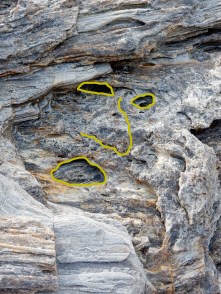
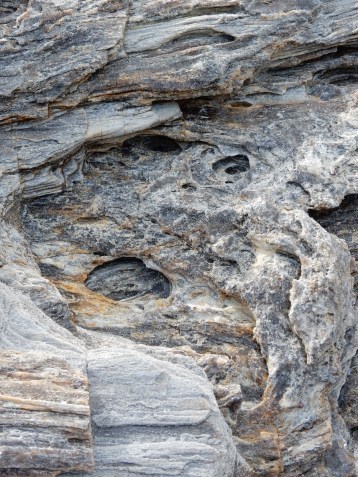
Whether it’s creepy or quirky, it has me looking for faces “trapped” around me. When I visited some interesting rock formations recently, I found myself thinking again of this poem and looking for those faces. I was mesmerized by the swirls and whirls and pits of these rocks. The more I looked, the more I felt like there must be faces there if only I looked in just the right way. Do you see any in this one?

DSCN7273
Or in this one?
DSCN7270
I confess, I didn’t ever see any in the top photo, but here’s what I saw in the second one:
DSCN7270 (1)
Did you see it? What do you think about Creatures–quirky or creepy?
For more poetry, go to Tara’s blog A Teaching Life for the Poetry Friday Roundup.
*Note–I apologize for the odd spacing. The only advice I could find on line about fixing it involved making code changes–That scared me much more than howling faces locked in rock and wood!

Too Quick to Judge

11454297503_e27946e4ff_h

DSCN7317

During these long, lazy summer days, I’ve spent a lot of time watching the birds. I’m simply fascinated by the activity around the suet feeder. Birds come and go all day long. Some posture and protest the arrival of others with threatening calls, open beaks and wing flapping. Some make room and comfortably share the feeder. It’s a never-ending show! The loudest and most common visitors are blue jays whose awful reputation as nest, egg and nestling stealers precedes them.

DSCN7307

Oh, you blue jays!
You awful, raucous birds
whose calls splinter
the serenity of morning
as you posture and defend
your post at the suet basket,
gorging and spraying seed
with greedy abandon.

Oh, you blue jays!
You egg- and nest- stealers
who feast on nestlings
and dominate the feeder
til at long last, sated,
you flash into the sky
with piercing cries,
flaunting plumage
glazed in stunning blue.

Oh, you blue jays!
If I didn’t know your nature,
your beauty would dazzle me.

Molly Hogan (c) 2016

After writing the above poem, I researched blue jays and was fascinated by what I learned.

  • They communicate with a variety of calls and use their perky crests to show their mood: A lowered crest indicates relaxation, as when feeding peacefully or tending nestlings, while an erect crest indicates surprise or aggression.
  • Blue jays are skilled mimics. Their red-shouldered hawk imitation is quite convincing and they may use it to warn of a hawk’s approach and/or to disperse other birds from feeding areas.
  • Jays are especially fond of eating acorns and store them in caches. One study of six radio-transmitter-tracked jays found that each one cached between 3,000-5,000 acorns and later retrieved  about 30% of them. It’s not so difficult to believe then that this hoarding behavior has been credited with helping to redistribute oak trees after the last glacial period. (Isn’t that amazing!?)
  • While it does sometimes occur, it is not common for blue jays to eat the eggs and nestlings of other birds.
  • Finally, though they have a reputation for being aggressive, there are studies that show jays being bullied away from feeders by other birds.

    So, after learning all of this, I’m feeling a bit judgmental now–too quick to condemn based on rumor and pre-conceived notions. As a result, I’ve perhaps misjudged jays and simultaneously deprived myself of enjoying their colorful plumage.  There’s a larger life lesson here but I won’t belabor the point. For now, though I still won’t enjoy their raucous cries, I will watch the jay action at the feeder with a more open and informed eye and allow myself to enjoy their stunning beauty. Perhaps I’ll even begin working on an apology poem.

For those of you who aren’t familiar with it, here is a recording of their strident call:

Famous

poetry+friday+button-e1341309970195In the midst of these troubling times, I turn again to poetry for solace and for hope. I’m sharing the end of the poem Famous by Naomi Shihab Nye. (To read the complete poem, please click on the title.)

I want to be famous to shuffling men
who smile while crossing streets,
sticky children in grocery lines,
famous as the one who smiled back.

I want to be famous in the way a pulley is famous,
or a buttonhole, not because it did anything spectacular,
but because it never forgot what it could do.
DSCN4471
Naomi Shihab Nye’s poem reminds me that making a difference doesn’t have to involve doing spectacular things. Each day brims with the potential to create positive interactions and connections if I focus on what I can do or change instead of being overwhelmed by what I can’t. There is comfort in that.
For more poetry, go to Margaret Simon’s wonderful blog, Reflections on the Teche.

An Evening at the Beach

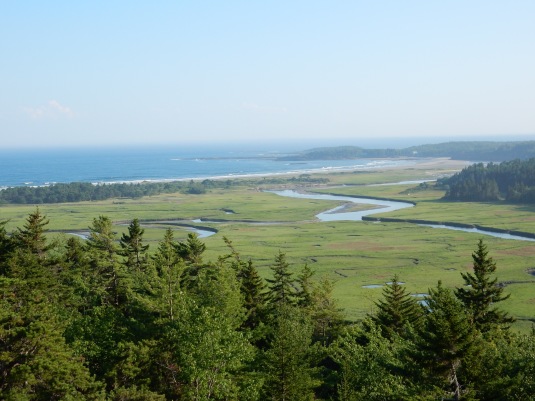
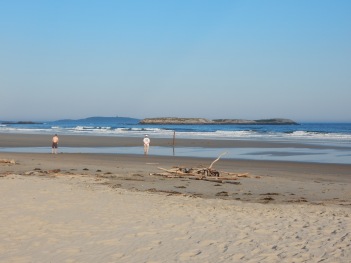
11454297503_e27946e4ff_hThis past Friday evening after a hot, hot, humid day, we decided to head to the coast to hike over Morse Mountain and down to Seawall Beach. This off-the-beaten-track hike is one of my favorites. (I’ve written about it before (here).) Parking at the trail head is strictly limited (40 vehicles or so) and it’s about a two mile hike in to a pristine beach. Limited parking means no crowds and the long walk nixes beach paraphernalia and ensures that driftwood stays at the beach. There are no facilities at the beach. It’s plain, simple, gorgeous beach and when the tide is out, there’s a lot of it!

Arriving at the parking lot, we were already congratulating ourselves on our choice– at 6 pm there was plenty of parking and the car thermometer showed that the temperature had dropped 10 degrees during our drive down the peninsula.
DSCN7159 DSCN7063

We set out into the woods and soon emerged to wend our way through the marsh where the tide has carved deep channels through the vivid green grasses. Stopping to watch crabs battling in shallow water, we  were soon locked in our own battle with mosquitos and biting flies. Unfortunately, this hike is often buggy, so we’d hoped for the best but come prepared for the worst. We sprayed our toxins and continued on our way trailing a cloud of Deep Woods Off.

Heading up the slope toward the mountain, we enjoyed the cooler temperatures amidst the towering pines, talking quietly and appreciating the interplay of light and shadow on trees, moss, and giant rocky boulders. At one point we saw a red fox casually step onto the trail ahead of us and then saunter across the trail and into the woods. Red squirrels chittered at us now and again and birds called repeatedly. When we reached the top of the mountain we took a short side trail to enjoy the view which, although hazy, was still impressive.

DSCN7068
DSCN7079After that detour we hit the trail again, descending and weaving in and out of more marsh and forest. Salty air and the thunder of waves welcomed us as we finally arrived at the beach to find it almost deserted and filled with amazing evening light.  One direction was sunny and clear, the other hazy and moody. The tide was out and the sky reflected in the wet sand. Clouds scudded across puddles.

We went our own ways, wandering, enjoying and soaking in the serenity. I was mesmerized by the interplay of water, clouds, and sand and the change in the light from moment to moment. Everywhere I turned there was some new wonder to savor. The trifecta of water, sky and clouds worked its magic again. A moment on a beach on a hot summer evening. A slice of heaven.

DSCN7090


DSCN7091DSCN7126

DSCN7093 (3)

DSCN7129


Quantity and Quality


IMG_0482

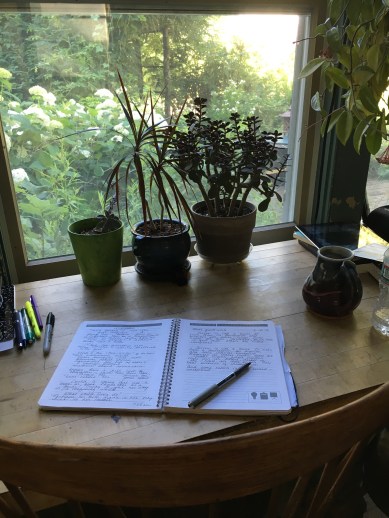
My morning writing spot

Late this spring I read a blog (probably through Slice of Life) and the author shared her goal to write 3 pages a day each morning in a writer’s notebook. She invited others to join her in doing this.  (If anyone remembers who blogged about this, please let me know so I can mention her by name and thank her for motivating me!) So, these days after I make my coffee and feed the cats, I take about 5-10 min. to glance at e-mails, messages, etc. then I close my computer and write in my notebook. I’m writing at least three pages almost every day. It’s a hodgepodge of thoughts, concerns, poems, story ideas, etc., but it’s amazing how quickly the pages pile up! For some reason I got into the habit of writing my starting and ending times, and I’ve found that it only takes me 15-20 min to fill three pages. (So, once school starts back up, I’m going to have a harder time convincing myself that I can’t find time to write!) But sometimes I wonder about the quality of what I’m writing. Will I do anything with all this … stuff!? Will it really serve any purpose? Will it help me with my writing?

I’ve heard/read two different things recently that relate to this and have really stuck with me and reassured me:

Not long ago I heard someone talking on the radio, recounting a pottery teacher’s experiment with his class*. The teacher divided students randomly into two groups. Group A was told to make as many pots as they could. Their final grade would be determined by the weight of what they produced: 50 pounds=A, 40 pounds=B, etc.  Group B was told they needed to make just one pot and they would be graded on the quality of that pot. At the end of the class all of the highest quality pots came from Group A. Apparently the first group dove in and started making pots immediately. As they created, they also learned, tweaking and improving along the way. The second group , intent on creating one single perfect pot, was less productive and their final results were not as high quality. Fascinating, right?

Then I read an interview in which Tom Petty told a story about touring with Bob Dylan in Australia. Apparently an interviewer was giving Dylan a hard time, claiming his songs weren’t as relevant now as they had been. Dylan’s response was “Well, I’m out here writing songs. What are you doing?”

So, my plan for this summer has been simple. Create a quantity of writing and worry about the quality later. In other words: Write! Write! Write!

*I couldn’t find the original source for this experiment, but apparently it’s retold in the book Art & Fear: Observations on the Perils (and Rewards) of ARTMAKING, by David Bayles and Ted Orland

Moonrise on the Sound


poetry+friday+button-e1341309970195

13775978_10205319850270687_5643720344231171260_n

(Photo credit to Rick Hogan, 2016)

If I were to accept this gilded invitation
to step upon the moonlit path and
feel the cool water pooling
beneath my shoeless feet,
flowing between my toes…

If I were to follow the shining trail
’til I stood directly
below the glowing orb
and tilted my face upward
to bathe in moonshine
then rose on tips of toes
and stretched one hand
up, up, up…

Would I discover it still
out of reach?

Molly Hogan (c) 2016

To enjoy more poetry, please visit Chelanne’s blog, Books 4 Learning, for Poetry Friday Roundup.


Sunrise Conversation

11454297503_e27946e4ff_h
DSCN7022Maine summers have delightfully long days, but with the sun rising shortly after 5 am in July, it’s tough to get outside in time to greet the dawn. For some reason on Saturday morning I woke early and was immediately motivated to get up and out. After making my coffee, I drove down to the town landing then walked across the small park to the bay. The air was dense with moisture and mist drifted across the water. River flies swarmed in masses, emitting an audible hum. I walked down the gangway and onto the dock, feeling its soft roll under my feet.
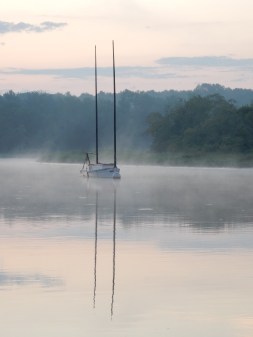
Moving forward, I sat down on the smooth planks, feeling the damp seep through my dress, sipping my coffee, and watching the sky lighten. Fish jumped occasionally, a few with startlingly large splashes, and birds called back and forth. Every now and then I took a picture.  Water, sky and a sunrise are a pretty unbeatable combination, and it had been too long since I’d enjoyed that rejuvenating trinity. I breathed in the serenity of it all.

DSCN7026

“Hello,” called a voice quietly.

I turned quickly. An older gentleman with a large camera slung about his neck was walking toward the dock. “Oh, Hi!” I said, standing up.

“I didn’t want to startle you,” he said, approaching. “Are you a photographer or a birder?”

“A little bit of both,” I replied. “How about you?”

“Oh, me, too,” he said, “but mostly a birder.”

We talked softly of the beauty of the morning and the bay and of birds we’d seen recently. I told him about the pileated woodpecker that was visiting my suet feeder and recounted my morning sunrise with a heron last fall. He shared tales of a visiting yellow warbler and an indigo bunting. He told me about a local beaver dam and confided that after weeks of trying, he’d finally gotten a couple of good shots of the beaver. He confessed that he had 28 bird feeders in his yard.


“I’m Roger,” he said, after we’d talked for a few minutes.

“I’m Molly,” I replied.

“Well, Molly,” he said, “I’m going up around the corner. There’s a spot I know there where I usually see some birds. I saw two herons there the other day.” He paused then continued, “I just wanted to say hello. Have a nice day.”

“You, too,” I said. He walked away and I turned back to the water. The sun had continued its ascent and the clouds glowed. I breathed in the serenity of it all.

It was going to be a beautiful day.

DSCN7014