

During these long, lazy summer days, I’ve spent a lot of time watching the birds. I’m simply fascinated by the activity around the suet feeder. Birds come and go all day long. Some posture and protest the arrival of others with threatening calls, open beaks and wing flapping. Some make room and comfortably share the feeder. It’s a never-ending show! The loudest and most common visitors are blue jays whose awful reputation as nest, egg and nestling stealers precedes them.

Oh, you blue jays!
You awful, raucous birds
whose calls splinter
the serenity of morning
as you posture and defend
your post at the suet basket,
gorging and spraying seed
with greedy abandon.
Oh, you blue jays!
You egg- and nest- stealers
who feast on nestlings
and dominate the feeder
til at long last, sated,
you flash into the sky
with piercing cries,
flaunting plumage
glazed in stunning blue.
Oh, you blue jays!
If I didn’t know your nature,
your beauty would dazzle me.
Molly Hogan (c) 2016
After writing the above poem, I researched blue jays and was fascinated by what I learned.
- They communicate with a variety of calls and use their perky crests to show their mood: A lowered crest indicates relaxation, as when feeding peacefully or tending nestlings, while an erect crest indicates surprise or aggression.
- Blue jays are skilled mimics. Their red-shouldered hawk imitation is quite convincing and they may use it to warn of a hawk’s approach and/or to disperse other birds from feeding areas.
- Jays are especially fond of eating acorns and store them in caches. One study of six radio-transmitter-tracked jays found that each one cached between 3,000-5,000 acorns and later retrieved about 30% of them. It’s not so difficult to believe then that this hoarding behavior has been credited with helping to redistribute oak trees after the last glacial period. (Isn’t that amazing!?)
- While it does sometimes occur, it is not common for blue jays to eat the eggs and nestlings of other birds.
- Finally, though they have a reputation for being aggressive, there are studies that show jays being bullied away from feeders by other birds.
So, after learning all of this, I’m feeling a bit judgmental now–too quick to condemn based on rumor and pre-conceived notions. As a result, I’ve perhaps misjudged jays and simultaneously deprived myself of enjoying their colorful plumage. There’s a larger life lesson here but I won’t belabor the point. For now, though I still won’t enjoy their raucous cries, I will watch the jay action at the feeder with a more open and informed eye and allow myself to enjoy their stunning beauty. Perhaps I’ll even begin working on an apology poem.
For those of you who aren’t familiar with it, here is a recording of their strident call:
 In the midst of these troubling times, I turn again to poetry for solace and for hope. I’m sharing the end of the poem


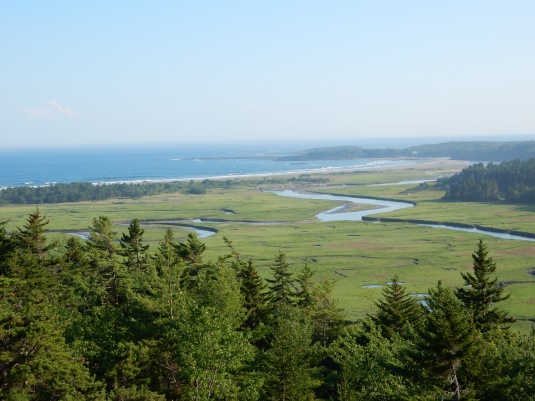
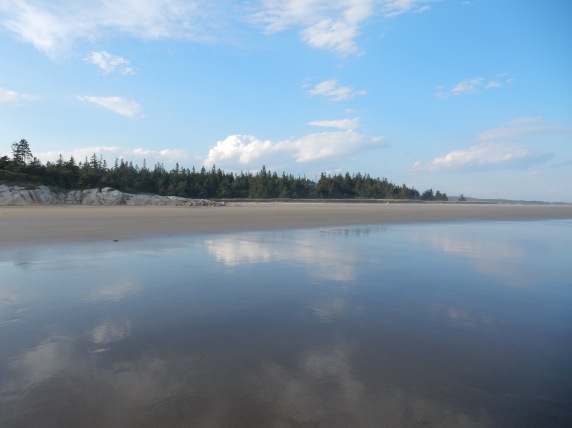
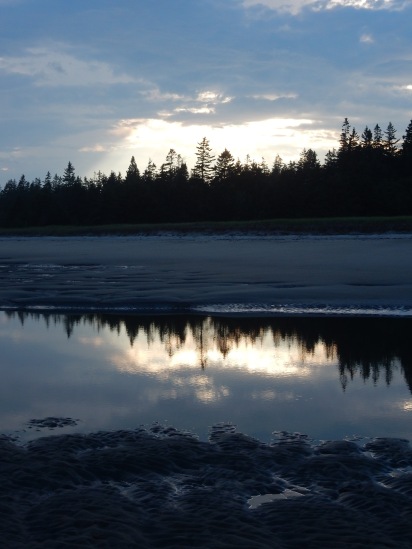
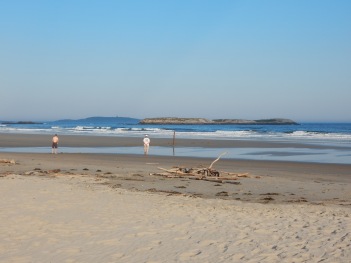 After that detour we hit the trail again, descending and weaving in and out of more marsh and forest. Salty air and the thunder of waves welcomed us as we finally arrived at the beach to find it almost deserted and filled with amazing evening light. One direction was sunny and clear, the other hazy and moody. The tide was out and the sky reflected in the wet sand. Clouds scudded across puddles.






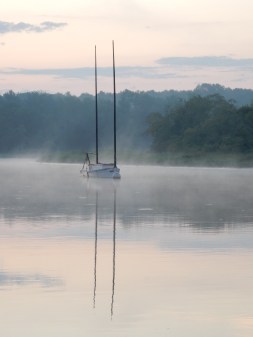
 Maine summers have delightfully long days, but with the sun rising shortly after 5 am in July, it’s tough to get outside in time to greet the dawn. For some reason on Saturday morning I woke early and was immediately motivated to get up and out. After making my coffee, I drove down to the town landing then walked across the small park to the bay. The air was dense with moisture and mist drifted across the water. River flies swarmed in masses, emitting an audible hum. I walked down the gangway and onto the dock, feeling its soft roll under my feet.


 Today’s Teachers Write exercise comes from Megan Frazer Blakemore. (She is one busy woman, as I just enjoyed her great presentation at ILA16 on Saturday and know she was signing her newest book,


