
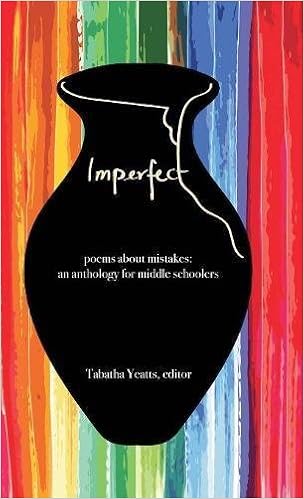
Not long after I first found out that I was going to have a poem in Imperfect: poems about mistakes: an anthology for middle schoolers, I shared the news with my class.
“Read the poem to us!” they chorused. So, of course, I did.
“Wow! That’s good!” someone said after I’d finished.
Another voice chimed in, “That’s not a poem! It’s like a story!”
So, we talked about different kinds of poetry for a few minutes.
“Read it again,” they said. So I did.
“That should be in a book,” called out a student, who may not have been listening closely.
“Yeah,” said another student, a close cohort of the first, who was clearly listening just as closely.
“Um, yeah,” I said, “It’s going to be. That’s what we were saying.”
“Wow!” they chorused. I stopped my almost eye roll and smiled at them.
“Yeah. Wow!” I thought.
Even though I knew I’d be receiving a copy of the book at home, I ordered myself a hardcover and had it delivered to school. After it arrived, I walked to the classroom, book in hand, still feeling amazed that I had a poem in this collection. My class was working with the Guidance teacher in the community area, and I had to walk right by them. They recognized the cover of the book in my hands from their bookmarks, and a chorus erupted.
“It’s here!”
“She got it!”
“Can we read it later?”
Later, when we were back in the classroom, we gathered at the carpet to read.
“Where’s your name?”
“Can we see it?”
They all edged closer to see.
“Read yours to us!”
“Yeah, read it again!”
So, I leafed through the pages and read my poem to them and then a few more poems.

“What are those marks on the pages?” they asked.
I explained about kintsugu –how when something broke, the Japanese mended it with gold, emphasizing the beauty of the fracture, rather than trying to hide it. They celebrated the breakage, believing it enhanced the piece.
“That’s just like people,” J. commented. “We make mistakes and then we learn and we’re even more beautiful.”
The other kids nodded solemnly in agreement.
Now that was pretty much a perfect moment.

 For the past several years the pair of geese have come. When I travel south on Route 295, I see the adults’ long necks and bodies amidst the grasses. I search to see the goslings’ heads. Sometimes I can’t see them, but can detect their wake in the movement of the grass as they trail along behind their parents. As they grow, I delight in watching their little heads bob up and down as they hurry along.








 Nix the comfort zone