Each fall the ladybugs gather in the corners of our house. Whenever I see one, I think of the childhood lines, “Ladybug, ladybug, fly away home. Your house is on fire, your children alone.” This year I realized two things: One, this verse is really quite grim, and two, I wasn’t sure how the rest of it went, though I felt sure that there was more. So, I looked it up and learned a few things along the way. For example, did you know that ladybugs are referred to in Great Britain as “lady birds”? The most common version of the verse, traced back to 1750s England, goes like this:
Ladybird, ladybird fly away home,
Your house is on fire and your children are gone,
All except one,
And her name is Ann,
And she hid under the baking pan.
That ending didn’t sound familiar to me at all! There are many, many versions of this verse, some much grimmer (“your children will burn!”) and there’s also much debate about its origin. Was it chanted by farmers warning ladybugs to flee before burning the fields after the harvest? Was it a warning to pagans to go underground? Was it sung out to warn Catholics who participated in illicit celebrations of Mass in farmer’s fields?
And that isn’t all! Ladybugs have symmetrical spots, and many cultures consider them lucky. In the Netherlands the ladybug is used as an anti-bullying symbol and to raise awareness for the National Foundation against Senseless Violence. Tiles like this can apparently be found on streets and paths, and sometimes they’re placed at the site of a violent crime.

I also came across this verse, published in Favorite Poems Old and New, Selected for boys and girls, selected by Helen Ferris. As I read, I was at first charmed but the ending has a darker tone. (For a lucky bug, there don’t seem to be too many happy verses around!)
- Lady-bird, Lady-bird, fly away home
- the field mouse is gone to her nest
- the daisies have shut up their sleepy red eyes
- and the birds and the bees are at rest
- Lady-bird, Lady-bird, fly away home
- the glow worm is lighting her lamp
- the dew’s falling fast, and your fine speckled wings
- will flag with the close clinging damp
- Lady-bird, Lady-bird, fly away home
- the fairy bells tinkle afar
- make haste or they’ll catch you and harness you fast
- with a cobweb to Oberon’s star

The ladybug pictured above obliging posed for me while climbing on the plant in my bathroom. The black bat-like mark on her “face” made me think of superheroes, while echoes of that childhood verse lingered in my mind. One more not-so-cheery verse for the ladybug!
Valiant ladybird
spreads crimson carapace
soars to the heart of the blaze
to rescue children
who are already long gone
Molly Hogan (c) 2017
This week’s Poetry Friday Roundup is hosted by Lisa Coughlin at her blog, Steps and Staircases. Make sure to stop by and check out some poetry.

 4:15 am


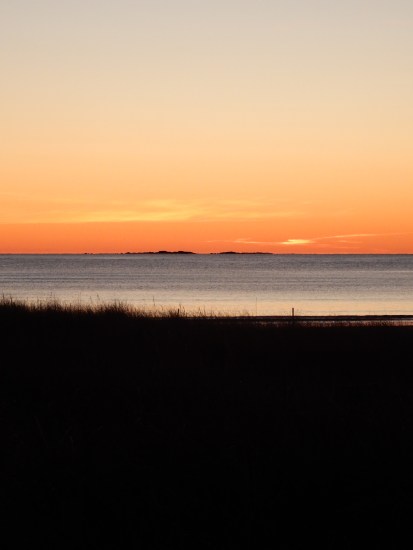




 The beach draws me in the off-season. There’s something about the wide expanses of sky, sand and sea that soothes me. On Sunday afternoon, my husband and I spontaneously headed to a nearby beach. The sand was indented with horse prints, deer tracks, dog prints, and lots of human footprints, but during our visit, the beach was uninhabited. We walked and walked and reveled in the solitude.
 The ocean has many moods and on this day it was especially serene. Off shore the buoys stood straight, not leaning over in the current or surrounded by tell tale ripples of water, divulging the force and push of the tide. No waves rolled in, crashing against the shore. Just the faintest wash of tide moved in and out, like gentle, rhythmic breathing. Even the birds seemed calm. For most of our visit, we watched one seagull walking along the shoreline ahead of us. He never took to the air, but contentedly strolled along.
 The tide was very low, lower than I’ve ever seen it, and ocean footprints rippled the sand, making fascinating patterns. Autumn leaves dotted the beach and clustered at the shoreline.