Some of my favorite holiday moments are times when I’m off to the side, watching or hearing loved ones. My heart warms to hear my children laughing together, the gentle hubbub of cousins’ catching-up conversations, a piano playing, or, on this past Thanksgiving, two voices raised in song.
In Thanksgiving
In the living room my brother-in-law strums his guitar My daughter’s soprano rises, mingles with his voice
As they sing John Denver’s “Country Roads,” I close my eyes to cradle each sound each nuance of this moment precious and pure
In that instant I know I’m already exactly where I belong
Wishing you all warm and wonderful memory-making during this holiday season.
The Poetry Friday Roundup is hosted today by Irene Latham at her blog, Live Your Poem. Be sure to stop by and check out what’s on offer there. It’s a rich repast indeed!
After reading the last page, I closed the book, “Houndsley and Catina,” and eased back in my chair.
My students and I sat quietly with the ending for a moment or two. Then I asked, “So, what did Catina and/or Houndsley learn? Do you think there was a lesson in this book?”
A hubbub of conversation erupted as kids started sharing their ideas.
“Friendship!” a couple of voices called out.
“Yeah, you don’t have to win a competition, you need to have friends,” someone said. Many students nodded in agreement. There was an enthusiastic chatter of like-minded comments.
One student sat quietly with his hand up, clearly waiting to contribute to the conversation. I called on him. “Well,” he said, slowly, “I actually learned a lesson from this book. I’ve been trying to get world records for a couple of years now. But from this book, I realized that you don’t have to have a world record or be famous to be cool.”
“How do you feel about that?” I asked him.
He hesitated, then responded, “I’m not sure.”
“Well, I also learned from this book,” C. announced with a grin. “I’ve always wanted to be famous, too, and…”he paused dramatically “…I’m still going for my goals!” he ended with a flourish. Then he added in a quieter aside, ” I also learned that friendship matters.”
“Friendship matters most!” V. chimed in.
“Yeah,” M. shook her head enthusiastically.
As we rounded up our discussion, mostly along the lines of the importance of friendship, C. raised her voice to share her idea, “I think what matters most isn’t what others think of you, but what you think about you.”
It was a pretty nice book discussion to round out the day in our second grade classroom.
If you’re a regular reader, you may know that the last few years have been particularly difficult for me. After a brutal battle with pancreatic cancer, my father died on Thanksgiving Day in 2021. Then, last spring one of my dearest friends received a dire diagnosis. She died in June. This past October my stepmother unexpectedly died. With one personal loss after another, on top of so much going on in our world at large, it’s been hard to regain any sort of balance and retain it.
I have many, many blessings in my life and much joy, but one of the greatest of them all is my husband, Kurt. Throughout all of this, he has been an incredible support. He’s been loyal, loving, steadfast and true. Our marriage (almost 34 years now!) has had its ups and downs, but overall, his presence in my life has enriched it and has made me a better person. I am beyond thankful for him.
Groundwater
I depend upon your constant presence your steady, vital flow like earth’s pulse percolating through permeable rock immeasurable invaluable sustaining, free-flowing you.
Wishing you all the best of the season. May you have someone in your life who cherishes and supports you. Who makes you laugh. Who holds you when you cry. And who walks beside you in the sunlight and in the darker hours.
The Poetry Friday Roundup this week is hosted by Karen Edmisten. Be sure to stop by and read the poem she’s sharing there: “Be Kind” by Michael Blumenthal..
We spent several days over the Thanksgiving holiday in Rye, NY with my sister and her family. On our first morning there I was delighted to accompany my brother-in-law to the dog park with their adorable dog, Maisy. I’ve heard a LOT about the dog park and was looking forward to it. Going to the park with Maisy has become part of my brother-in-law’s daily routine. He describes his daily time at the park as “like a cocktail hour, only quieter and with coffee.” He enjoys the time with the dogs, their interactions, and the complex social dynamics at play amongst both canines and humans. I enjoy hearing about them.
I’d been to Rye Town Park long ago, before my sister and her family were dog owners and part of the early morning dog set. It’s lovely, beautifully landscaped and abutting Long Island Sound. I was curious to see what the “dog park” part was all about, even though I am NOT a dog person. So, I eagerly set out, expecting the people interactions and the dog interactions, but little did I know that I would find a Poetry Friday post!
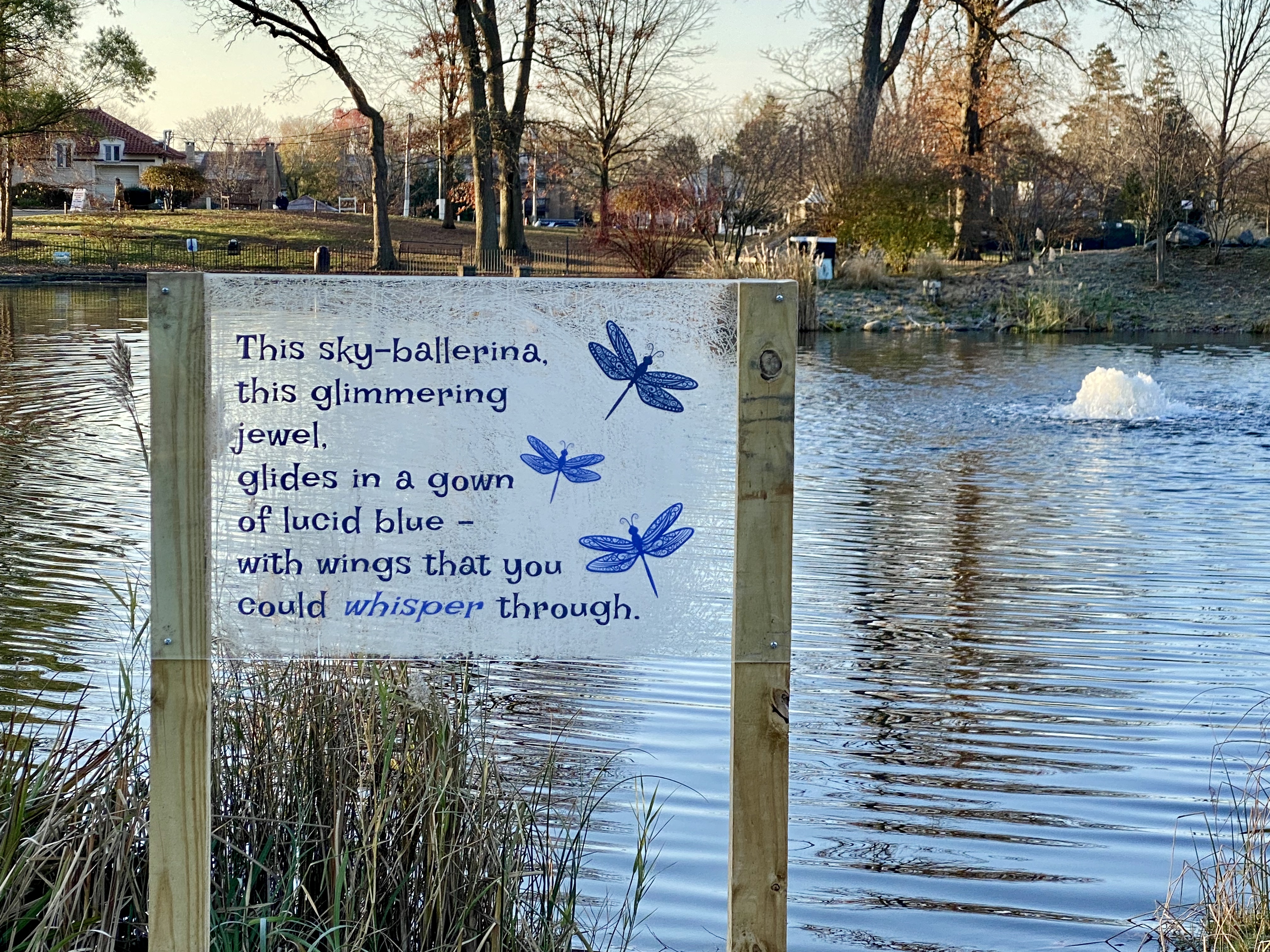
As we entered the park and walked by a small pond, I noticed this:
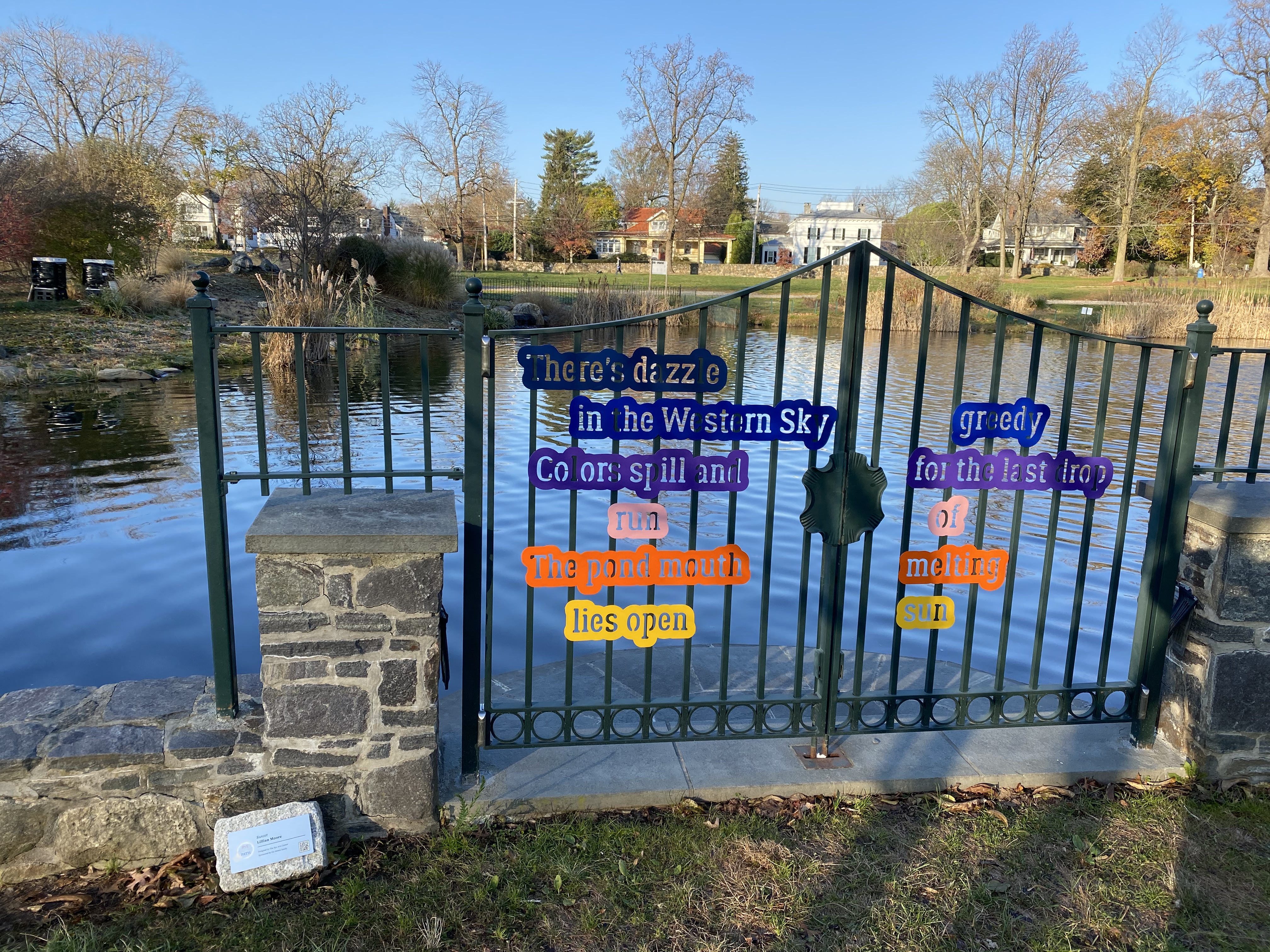
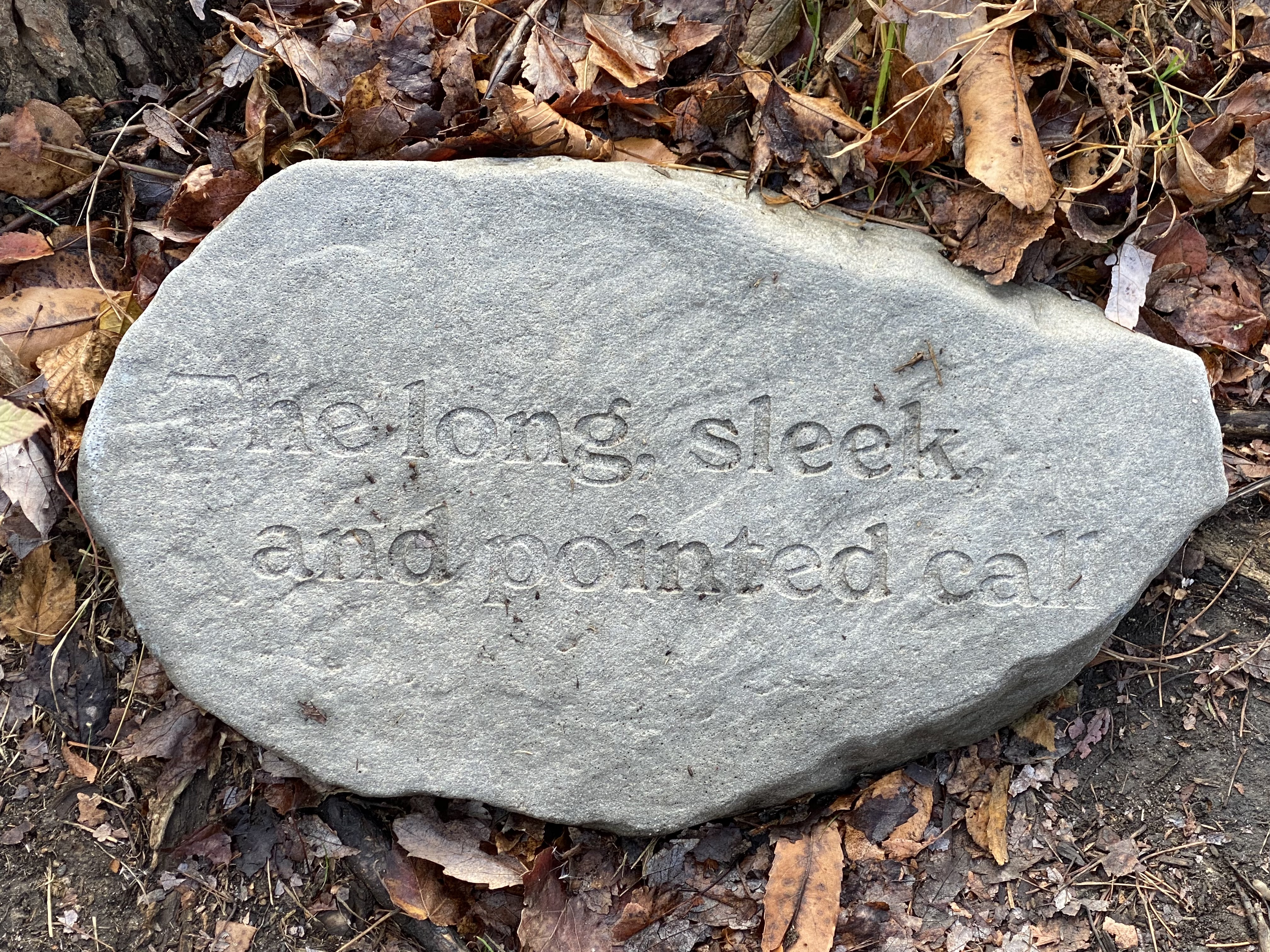
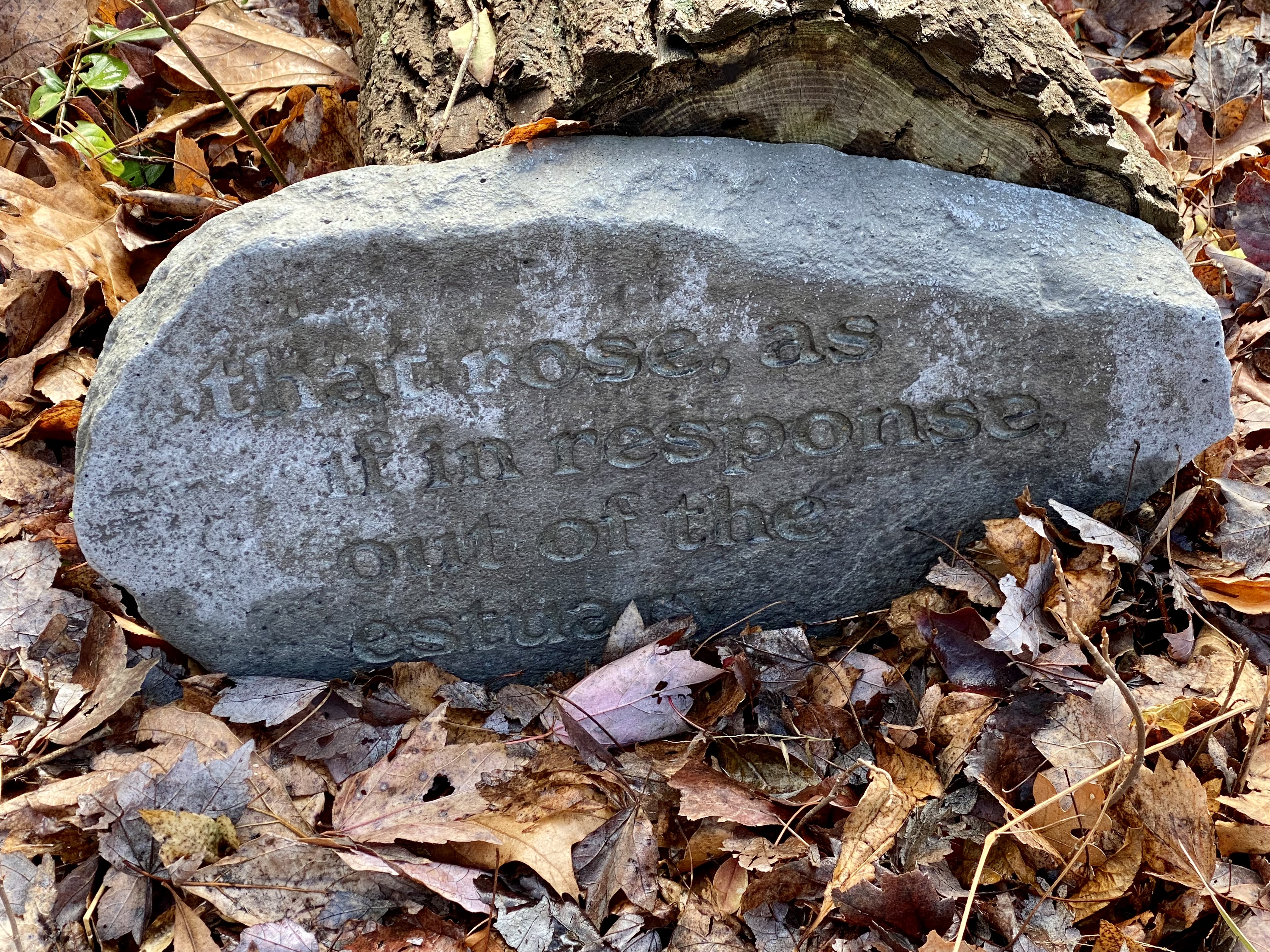
Then, right around the corner was this:
Forget about the dogs, there was poetry here! (I warned you that I’m not a dog person.)
It turns out that the town of Rye has a Poetry Path and the park is part of it. It’s liberally sprinkled with poetry in all sorts of creative installations. These were just two of many. Each one has a plaque that tells the name of the poem and the author. If you click on their site, you can read the poem and there’s a link to learn more about the author. According to the site, the poems are “a collaborative public art installation designed to spark reflection and conversation around themes of community, conservation, and social justice.” Rye Town Park provides a home for 39 of these poems in out of an 82-poem installation. The two above by Rebecca Kai Dotlich (here) and Lillian Moore (here) are just two of many that captivated me.
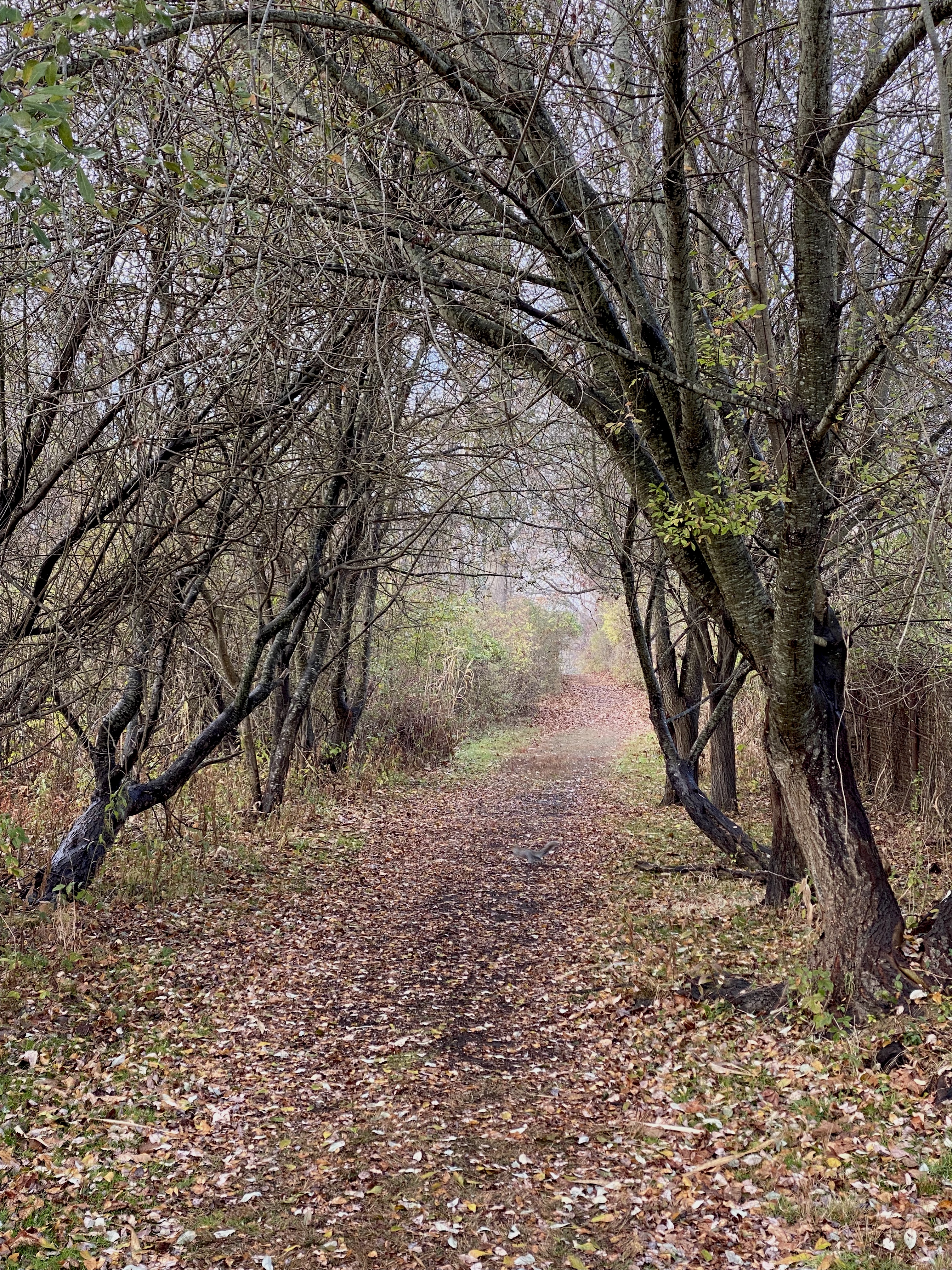
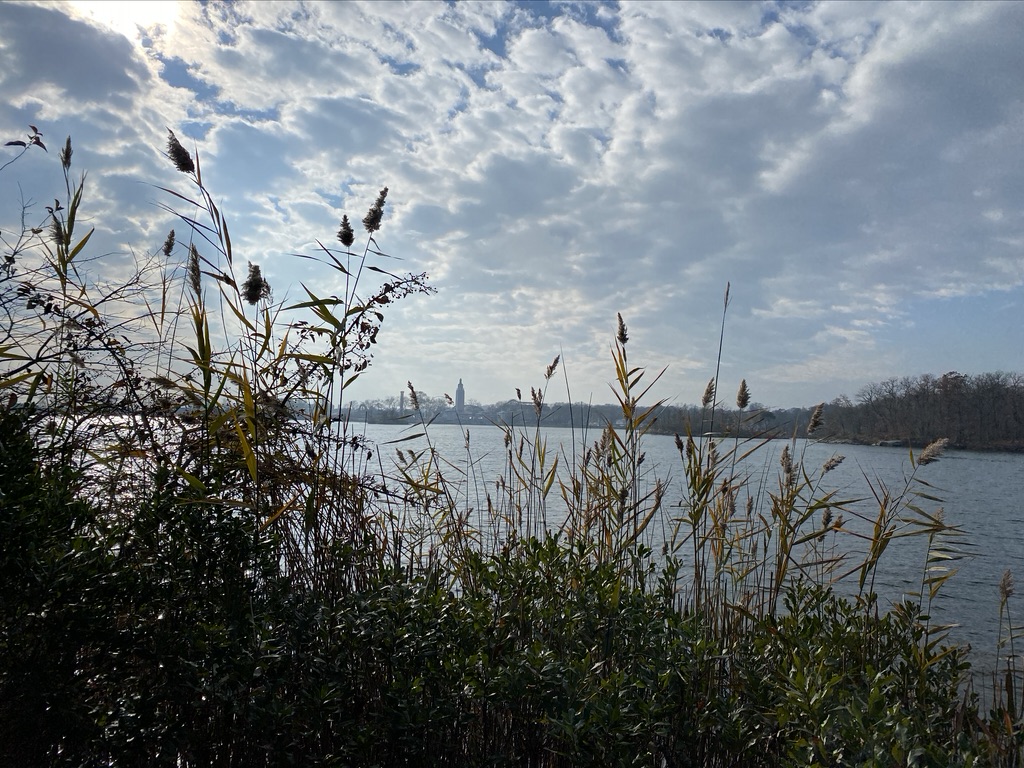
Then, before leaving on Friday, we took some time to walk at the nearby Edith G. Read Wildlife Sanctuary before getting in the car for our long ride home. It had been raining all day, and initially mist and clouds prevailed. Still, it was a lovely place to visit and as we walked, the skies cleared and the sun came out. We weren’t the only ones out and about enjoying the brightening day.
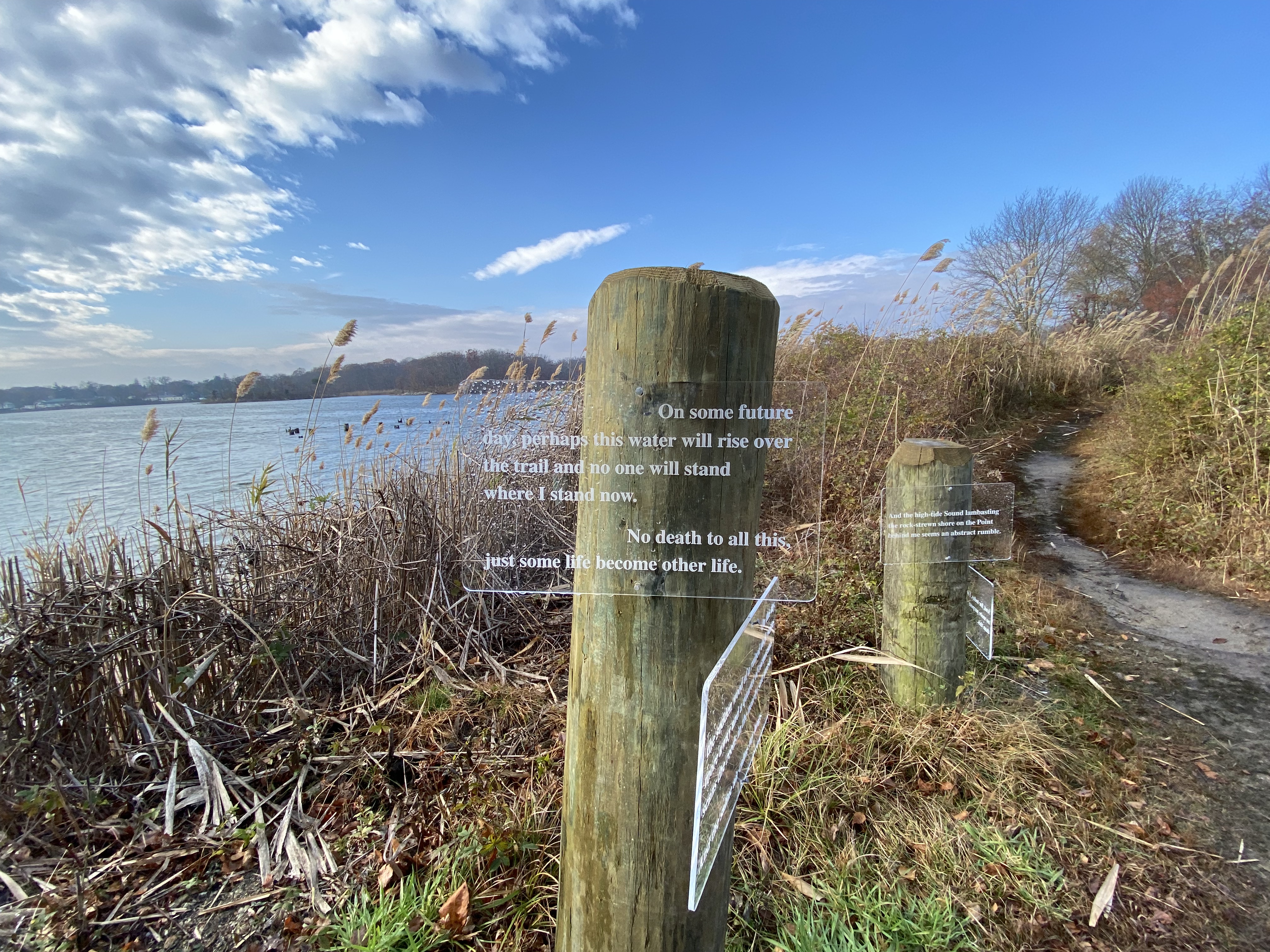
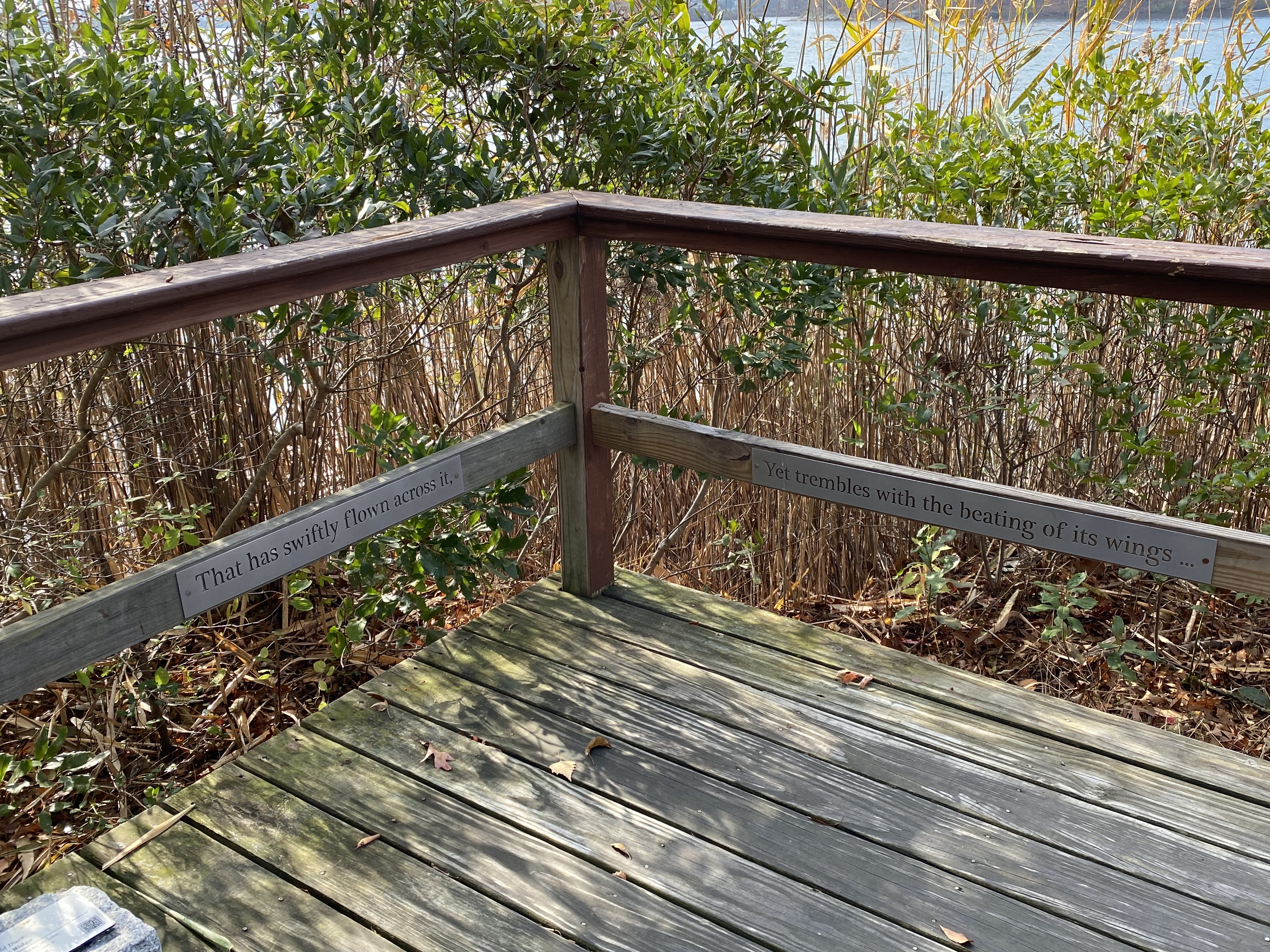
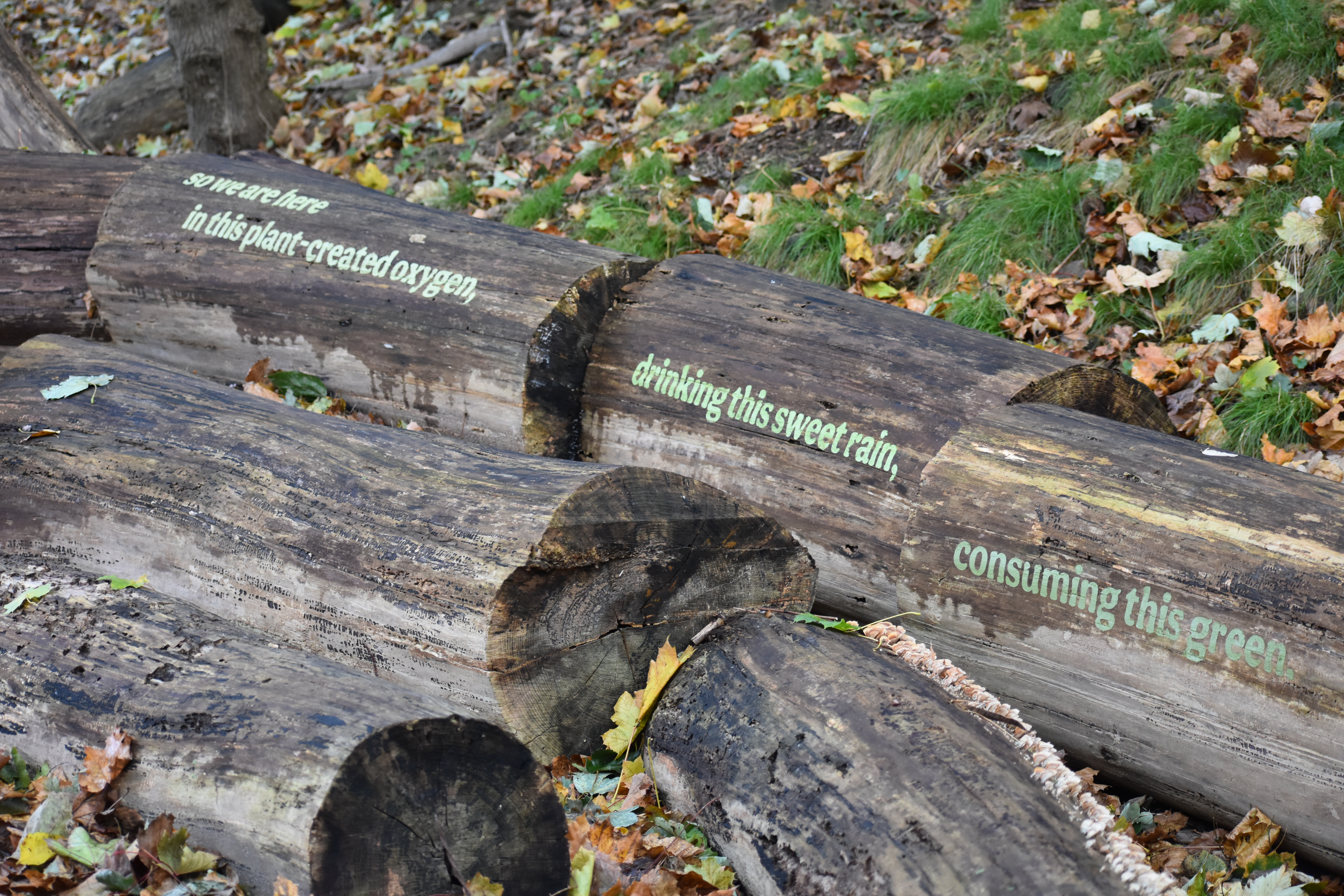
Here, too, much to my delight, there was poetry. We passed multiple installations and each one struck a chord. Apparently, the Rye Poetry Path has installed 16 poems here. They were perfectly situated and again, it was clear that the effort “to honor the spirit of the poem and the space it’s in” had been fully achieved.
On some future day perhaps the water will rise over the trail and no one will stand where I stand now. No death to all this just some life becoming other life.
As water, cleared of the reflection of a bird That has lately flown across it, Yet trembles with the beating of its wings, So my soul . . . emptied of the known you . . . utterly . . . Is yet vibrant with the cadence of the song Lola Ridge
…so we are here in this plant-created oxygen, drinking this sweet rain, consuming this green A.R. Ammons
… The long, sleek, and pointed call that rose, as if in response, out of the estuary of night and storm, said it knew well what the given world gave, and wanted more.
If I’d had more time, I would have enjoyed wandering through all the locations in Rye to find and savor each poem. As it is, the poems I did find, some familiar, some new-to-me, added a rich layer to my visit. What a wonderful initiative to bring poetry out into a community!
This week’s Poetry Friday Roundup is hosted by Michelle Kogan at her blog. She’s sharing a lovely poem and quotes and links from a recent NYT article about the ongoing work of artists from Ukraine.
I promised myself I’d try to blog twice a week again. After a long time not posting, getting back in the rhythm of Slice of Life and Poetry Friday felt like a stretch, but a positive one. And, last week I did it!
But that was last week.
This morning I knew it was Tuesday, and I told myself I’d think of something to write for Slice of Life during the day. I told myself that even though I knew full well that writing after school is NOT my jam. But still, I work with adorable second graders. How could I not find a story idea?
Still, I came home from work utterly uninspired. I didn’t want to write about the unfortunate-photo-on-the-iPad incident. Or how the first time two students sing you “The Twelve Days of Christmas” it’s endearing. The first time. Or about the amount of energy I expend trying to avoid sending students to the nurse. I didn’t really want to write anything.
Still, I thought about all the times I’ve read posts that other people started with the words, “I wasn’t going to write tonight…”. With them (and my promise to myself) in mind, I decided I should at least try. Maybe I could describe the fire in the wood stove, my sleeping cat, my on-going text conversation with my daughter, the Christmas tree lights glittering in the other room, the hum of Christmas carols playing from the radio in the kitchen… See, there’s a lot you could write, I told myself. So I opened a new page in my blog.
Has anyone else noticed this weird new thing that WordPress is doing? Ok, it could be that it isn’t new, but I have only recently noticed it. That happens to me sometimes. Anyway, when you start a new document, they now have a prompt or question. Once you start typing it disappears. Tonight it said: “What are 5 things you’re good at?” It struck me, in the midst of my struggle to find something to write about, that this new thing (that felt somewhat invasive the first time I noticed it) might actually be helpful.
Off the top of my head, without second guessing, I quickly typed my answers:
5 things I’m good at.
Baking
Taking pictures
Procrastinating
Avoiding uncomfortable truths
Changing the conversation
Hmmm…interesting. I wonder what WordPress will ask me next time? This could be the start of a beautiful relationship… or at least a Tuesday safety net! What are 5 things you’re good at?
I’ve barely participated in Poetry Friday over the past few months, but happily I happened to stumble upon Amy Ludwig VanDerwater’s recent post, “Answer an Unasked Question“. I was utterly enchanted by her poem called “Answer”, a whimsical imagining of taking tea with the moon. Amy invited readers to “Think of something someone might wonder, real or pretend…and then write a poem answering this question.” I passed her invitation along to the Inklings for our monthly challenge.
Here’s my response to that challenge, along with a big nod of thanks to Mary Lee for sharing the mentor poem “Because of a Redwood” (which heavily influenced my poem’s structure) and to Joe Cottonwood for writing it. I also think a bit of influence seeped in from a little book I found long ago called “The Tiniest Sound” by Mel Evans.
Why?
Because when I step outside and close my eyes I can hear the sun rising above the horizon inch by slow inch, probing its warm, gentle rays into piles of fallen leaves
Because there’s the faintest rustle as frost loosens its grip from limned leaves of maple, aspen or oak, shifts from glitter to flow, then lets go to drip drop onto crisply tousled grass then slowly seep into waiting earth where drowsy roots shift and murmur in greeting and gratitude
Because I can feel the air tremble and hum in anticipation of the coming day in all its fragile vulnerable wonderful newness
And because every single day the birds waken, eager to sing first a note or two then a burgeoning chorus that pierces the morning hush like a beam of light striking a crystal, splintering silence into a dazzling crescendo of glorious, vibrant waves that wash over me again and again So that anything and everything seems possible
Driving to school, I feel the stress accumulating. It’s like there are free-floating electrons of anxiety in the atmosphere, and I’m greedily scooping them all up. A big stress hoover.
As I drive along, thinking of electrons, a memory tugs at me: childhood shock wars. I haven’t thought of this in years, but suddenly I remember it all so clearly. How, once upon a time, my brother and sisters and I would put on our thickest socks and scoot our feet across the rug in large swooping steps, skating across the carpet. How we’d dodge and chase each other, not lifting our feet, still scooting, hoping to pick up more and more and more charge. Finally we’d stretch out, connect, and a bolt of shock would release from one to the other.
Zap!
“Ouch!” we’d yell. Or, “That was a good one!”
And then we’d laugh and laugh, and start scooting again.
I’ve been lingering in childhood memories lately and bracing for the next shock, whatever it might be. Missing my dad. Missing my friend. Grieving my newly lost stepmother. Mourning my relationship with my brother who’s chosen to remove me from his life. Trying to come to terms with this odd place and time called middle age.
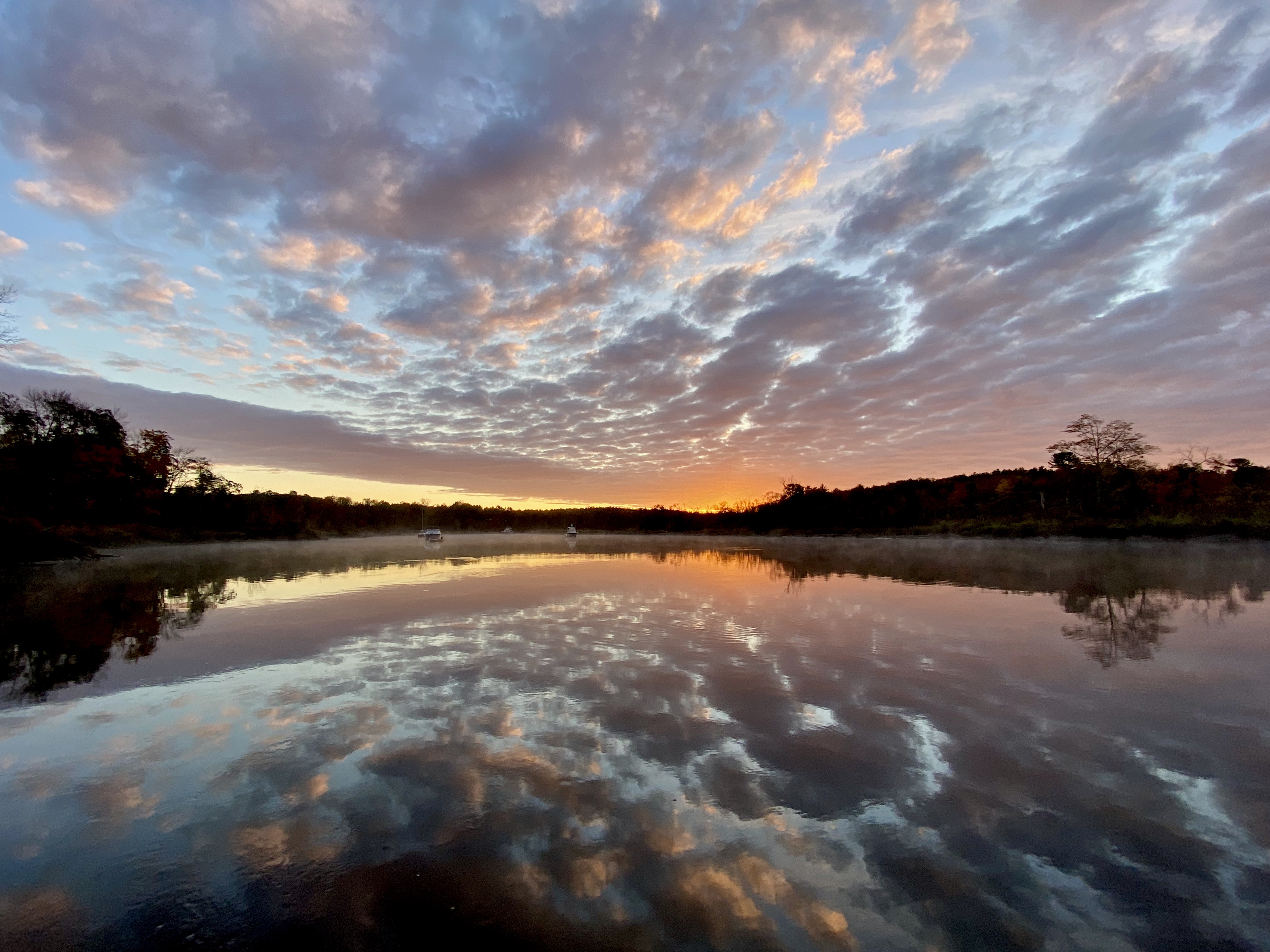
On this particular November morning, as I reminisce, the day is brightening around me. Sunrise is imminent. I notice the dark grey clouds gathering above the horizon. I try to remember what I once learned about clouds. Aren’t there electrons hanging out there, too? I’m pretty sure there are electrons in the clouds, and that when enough of them accumulate, they stream downward. Then protons surge upward, and …
Boom! Zap! Lightning! Thunder! Power unleashed.
As I watch, that potential is gathering on the horizon. It could mean a devastating storm is brewing, or even a minor one, but for right now, the clouds merely seem intent on enhancing the sunrise, sending fractured rays of lights to shimmer through layers of pink, gold, and blue. Without them, the sunset would not be nearly as spectacular. That’s something to remember.
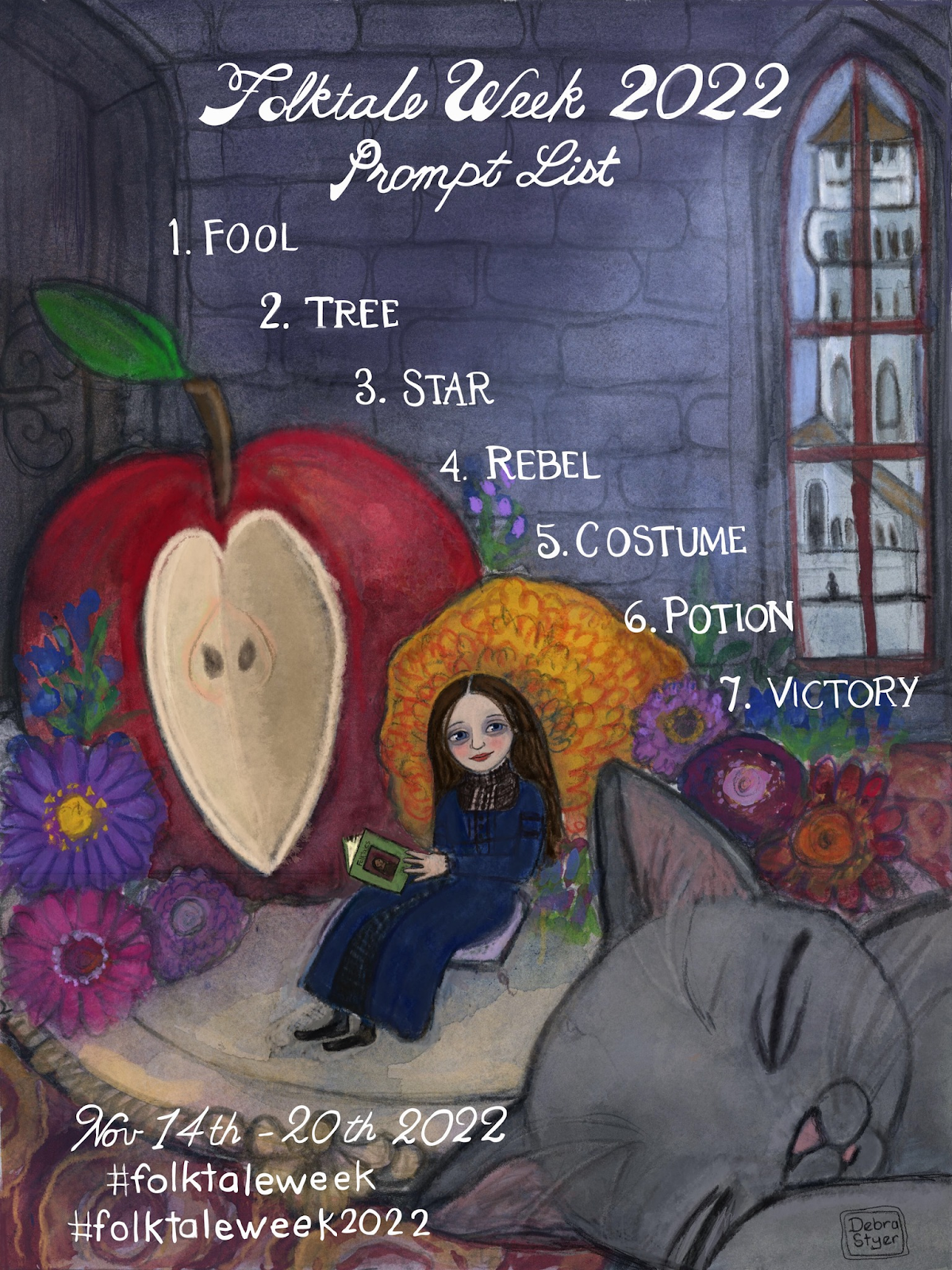
Linda had our Inklings challenge this month and she responded with an invitation to “find or write a poem in any form of any length for Folktale Week November 14-20, 2022.” The folks at Folktale Week describe the prompts as an opportunity to “search for your favorite folktales, discover new ones, work on your own amazing art, or even write your own tales.” Here is the prompt list with their accompanying lush illustration:
Unfortunately, October truly threw me for a loop this year, and I’m still struggling to regain my equilibrium. Very little writing happened. Then, although I recognized the richness and flexibility of the prompt, I had a hard time finding my way in. I pondered using fool, or potion, or star. I stopped and started. My thoughts turned time and again to tree and I remembered something about the Norse sacred tree, Yggdrasil (though I did not remember the name without a Google search). I don’t know much about Norse mythology or this tree, but remembered it was central to the universe. I was drawn to that idea–a tree uniting worlds, central to all. There’s some sort of infinite healing potential about a tree.
This poem doesn’t really feel ready for the light of day, and it surely doesn’t offer a tale, but I didn’t want to forgo participating in Linda’s challenge. I apologize in advance for the maudlin bent, but it seems to be what’s emerging from my pen these days.
Hand pressed to tree I stand alone soul barked and bruised yearning to be rooted to earth while soaring upward bridging worlds
yearning to cleave to now and then to here and there
Hand pressed to tree I stand still whilst splintering in all directions
Also, this week the Poetry Friday Roundup is hosted by Heidi Mordhorst who’s sharing her response to the Inkling challenge. Be sure to stop by My Juicy Little Universe and check out what she has on offer!
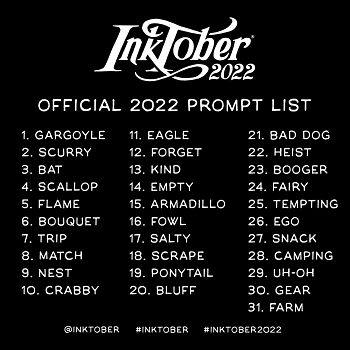
This year I’ve been trying again to write poems in response to the Inktober drawing prompts. I’ve only written to about half of the prompts so far, but hope to play more this weekend. Some of the prompts are quite challenging at first glance, and it can be interesting to see where they lead. Here are a few from the past two weeks:
Day #2: Scurry
Why the constant scurry? Trying to outpace worry? So fast. Too fast. Life gets blurry. Slow down. Take time. Less rush. Less flurry.
If you’re interested in trying out these prompts, here’s the list:
This week’s Poetry Friday Roundup is hosted by Matt Forrest Esenwine at his blog, Radio, Rhythm & Rhyme. He’s sharing exciting news about his newest book and an original poem as well.
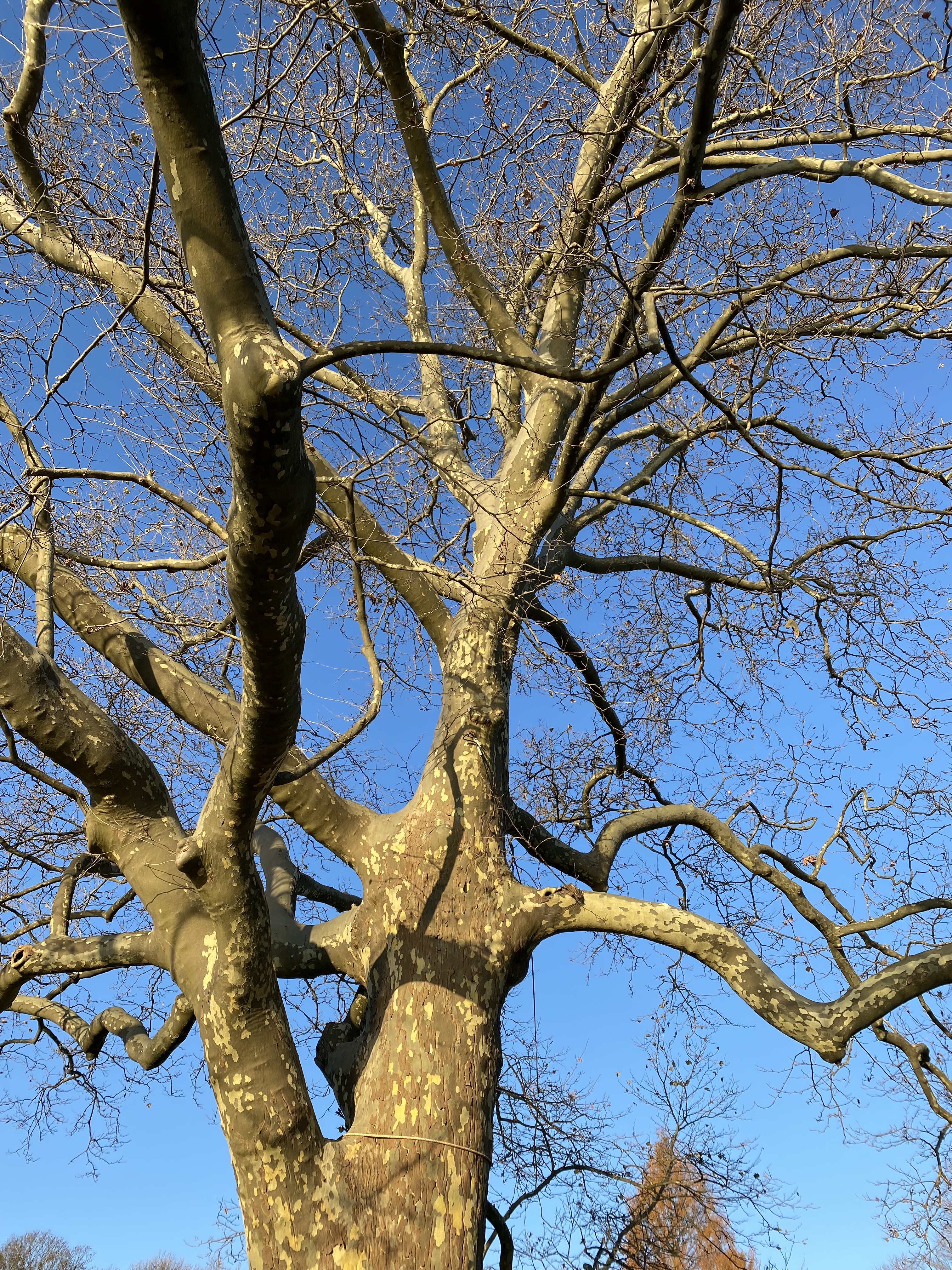
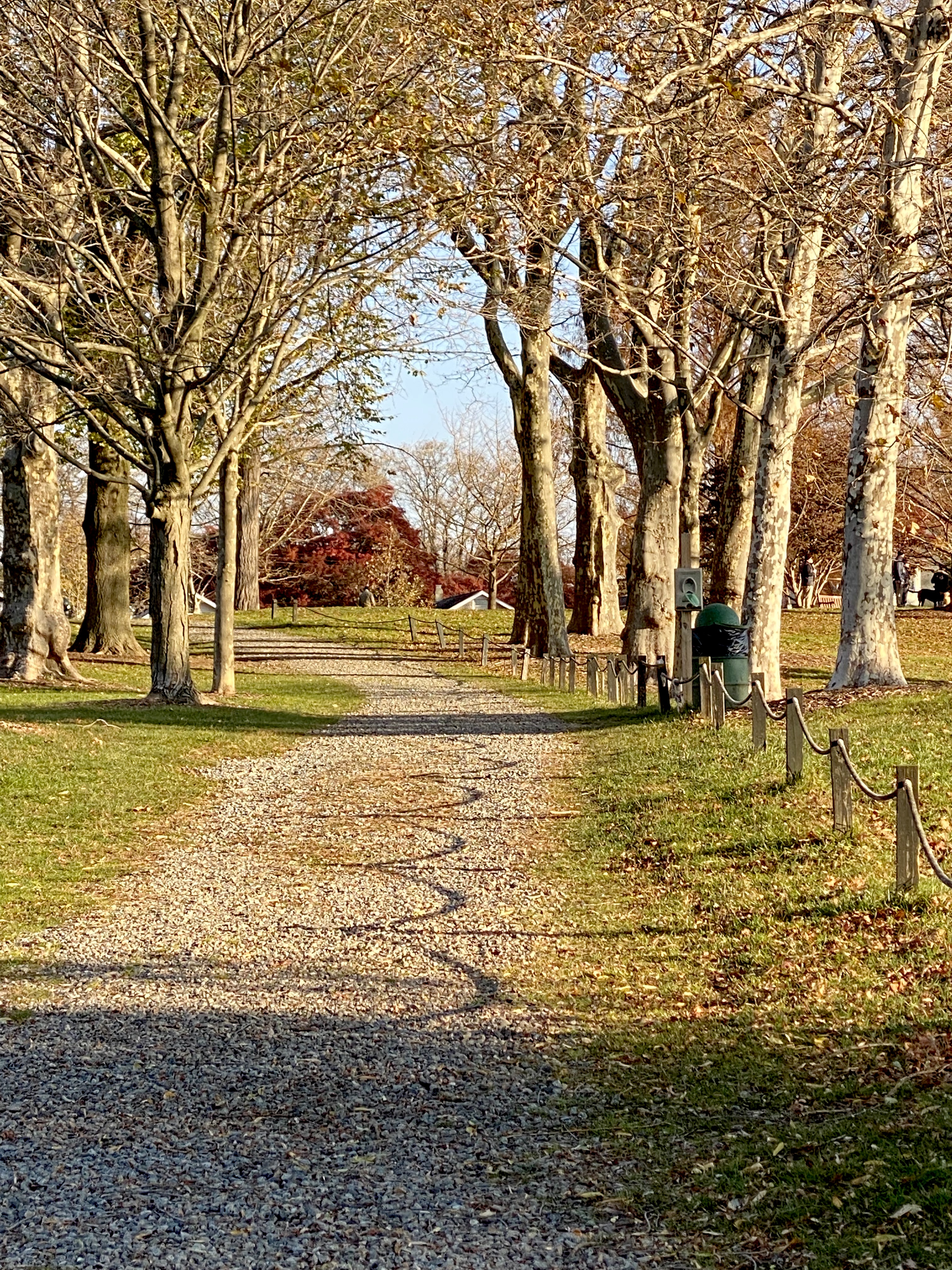
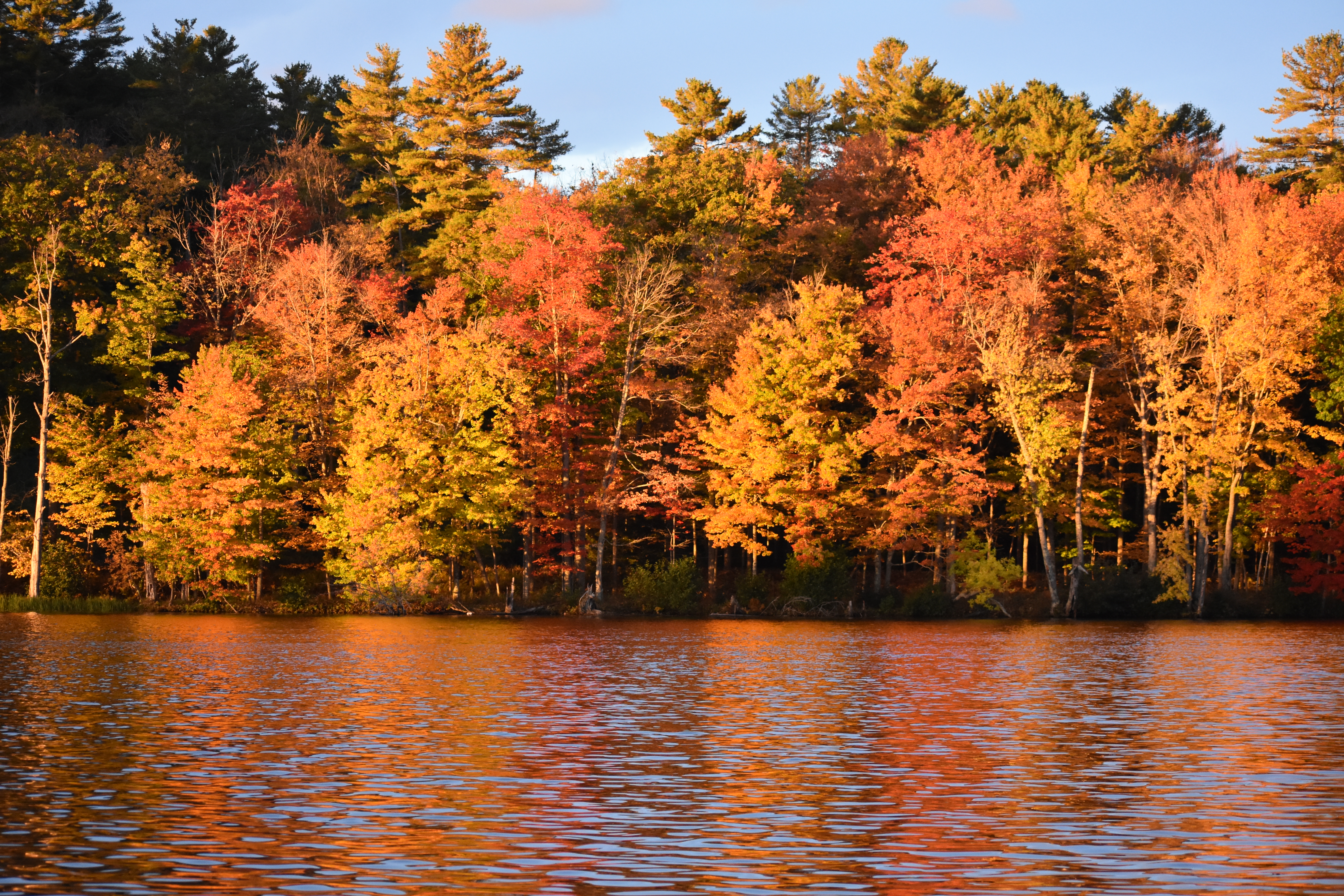
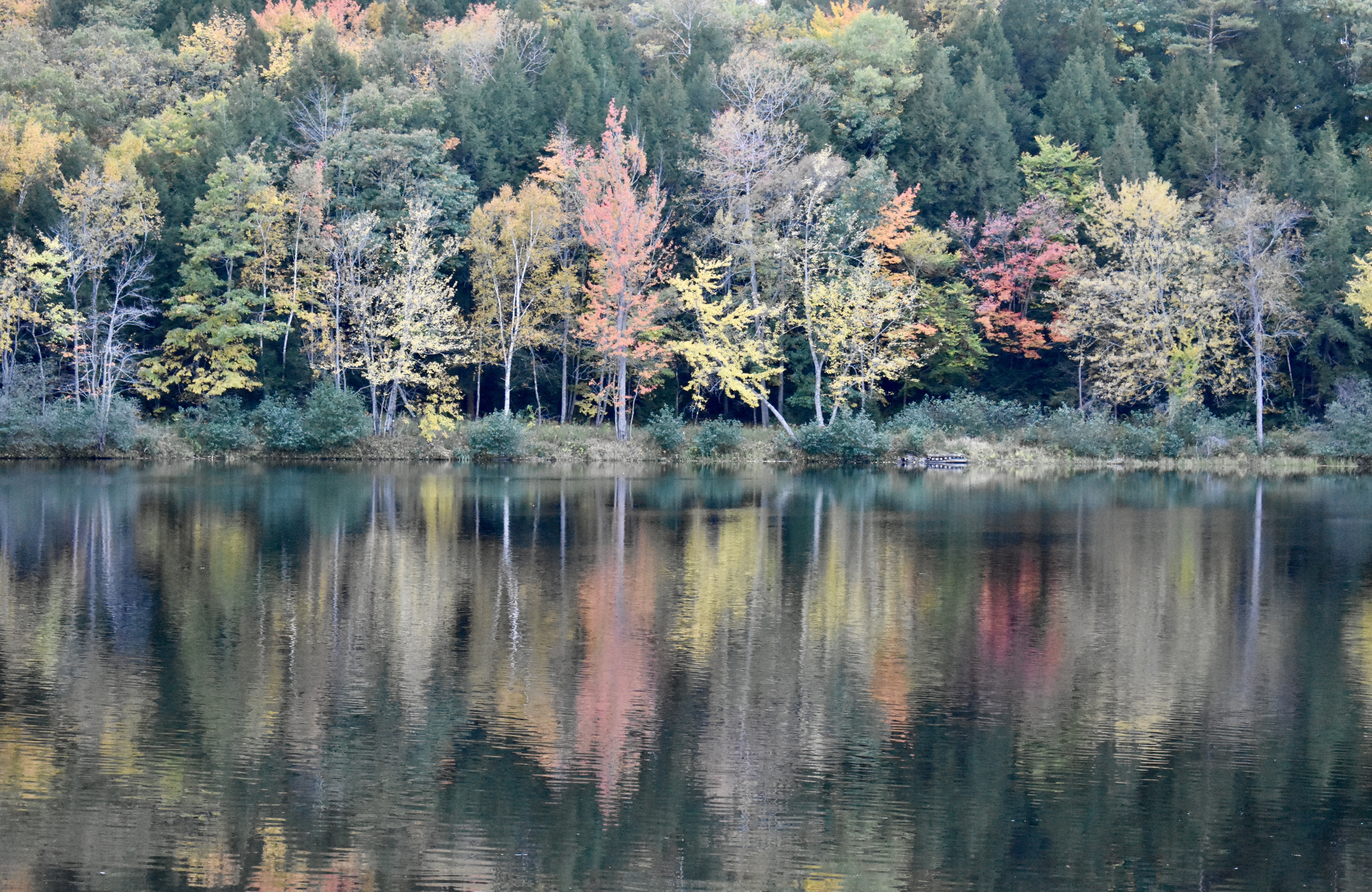
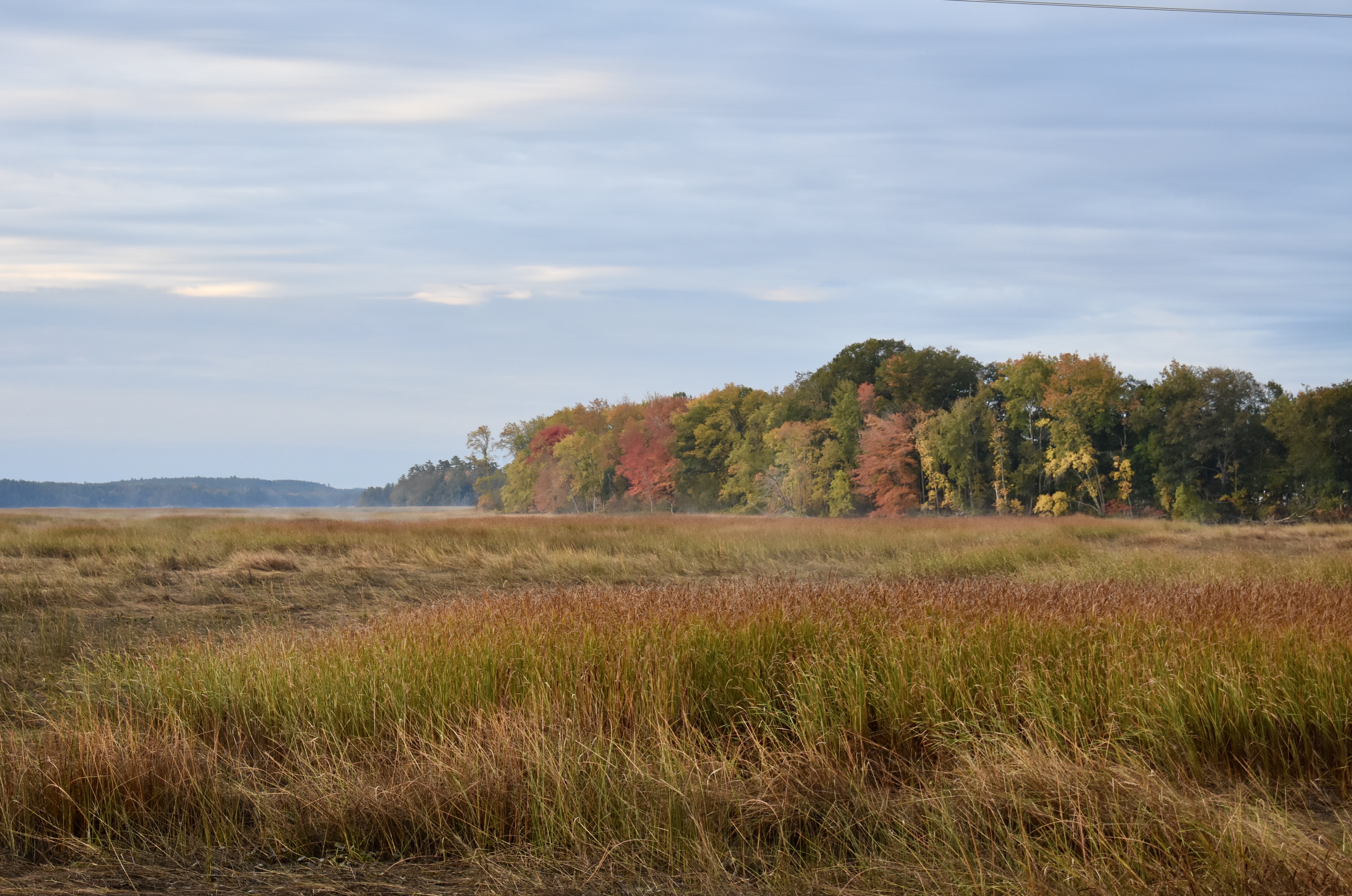
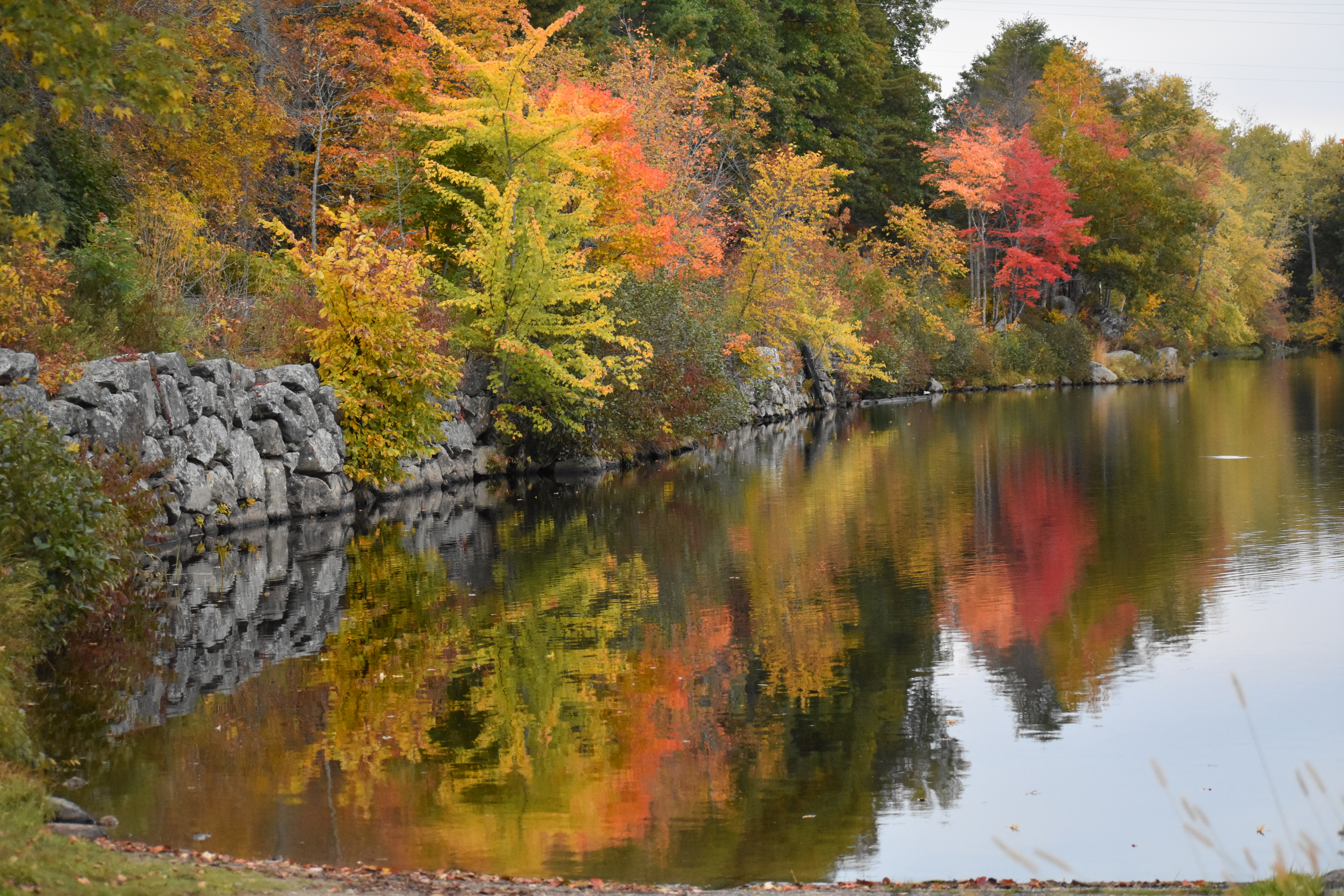
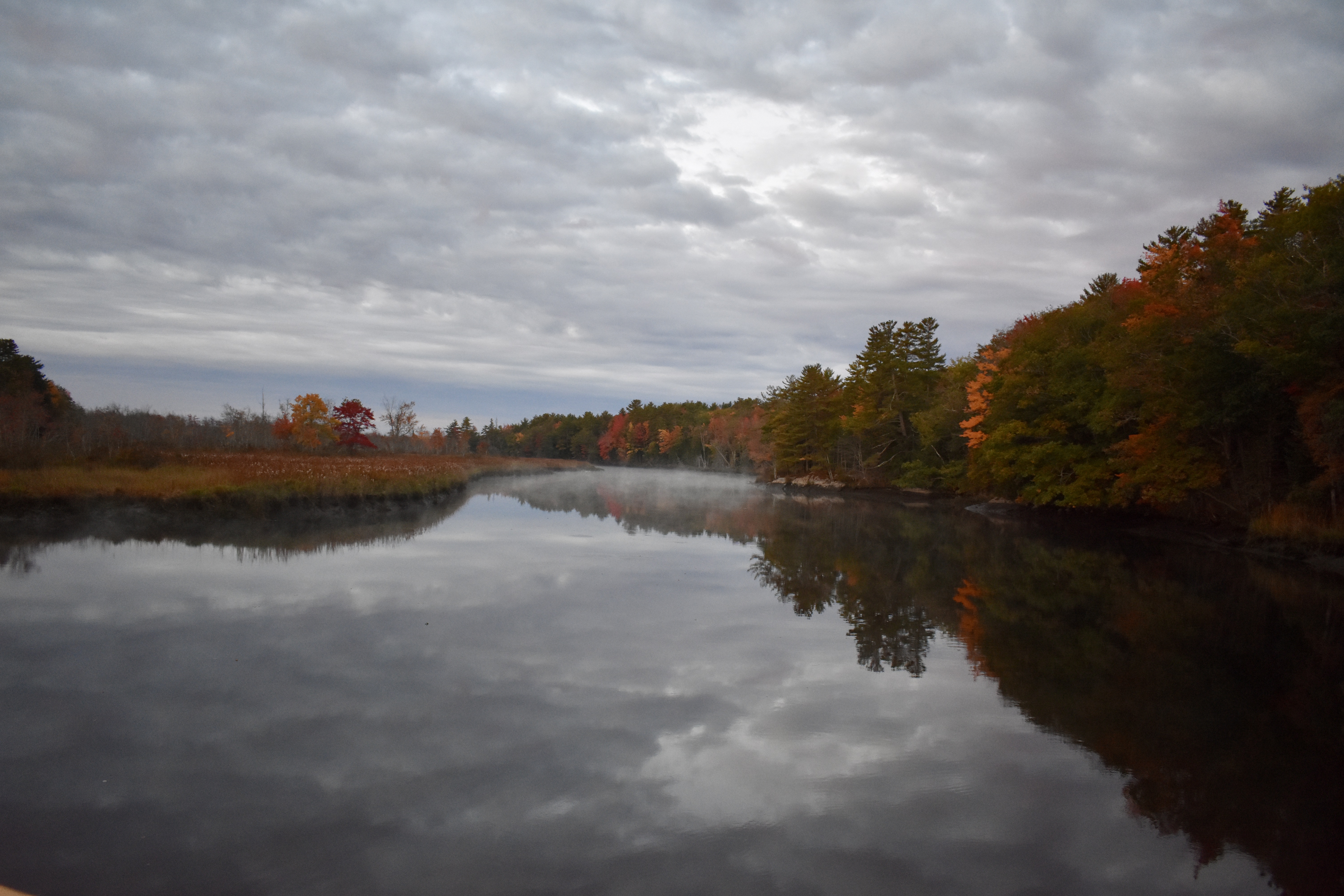
I’ve been out and about a lot lately, enjoying the spectacular fall foliage. Autumn really doesn’t know how to tone things down, does she? She’s the queen of gaud and exuberance and exults in every moment of it. I’m a delighted spectator. These days, no matter how late I’m running, I keep taking the long way home. Somehow the wheel turns and I’m heading along yet another detour, prolonging my immersion in the glorious parade of color. From country lane to marsh to river to harvested field, there’s a constant sense of anticipation, of wondering what technicolor marvels might be just around the next corner. Flames of crimson and gold leap about in the landscape, blazing into brilliant blue skies, reflecting off the water, and lighting up overcast days. It’s a non-stop autumnal extravaganza and I’m thankful for every moment of it.
sometimes I even allow people to be in my photos…sometimes…









 Nix the comfort zone