
A huge thank you to Two Writing Teachers for all that they do to create an amazing community of writers and a safe, welcoming space to write, learn, share and grow.
www.twowritingteachers.org
“There’s a woodpecker nesting in the tree above my office,” Kurt announced as he walked in. “I’ve seen it a bunch and it’s out there right now.”
“Really?! What kind?”
I think he answered me, but I’m not sure, as I’d already rushed outdoors, grabbing my camera as I went. I scanned the cluster of trees near his office, my eyes running swiftly up and down each tree trunk.
Where was it?
Was it there?
Or maybe there?
Yes! Yes! Sure enough, there it was! A red-bellied woodpecker!

Aren’t they gorgeous? That beautiful red head and black and white barred back is such a stunning combination. They actually have a faint blush of red on their bellies (Can you see it?), hence their name. (You’d think they should be called a red-headed woodpecker, but if you look those up, you’ll see why that name was already taken.)
Red-bellieds are one of my favorites and we’re lucky enough to see them regularly. Two summers ago we had a family of them visiting the feeders almost everyday. I was frequently drawn to the window to watch the parents forage at the suet feeder and bring chunks back to the three loudly-impatient babies who waited on an adjacent branch. Then they’d all swoop back off toward the trees. I never could determine which nesting cavity their tree was in, though I knew approximately where it was and I’d searched.
This past fall and winter we lost a lot of old trees during windstorms. Many of them clearly had been used for nesting cavity birds. We’d still seen the red-bellieds throughout the winter, but I’d been a little worried that they might move farther afield during nesting season. So, was this the bird Kurt had been seeing, or was it just visiting? Soon enough I had my answer.


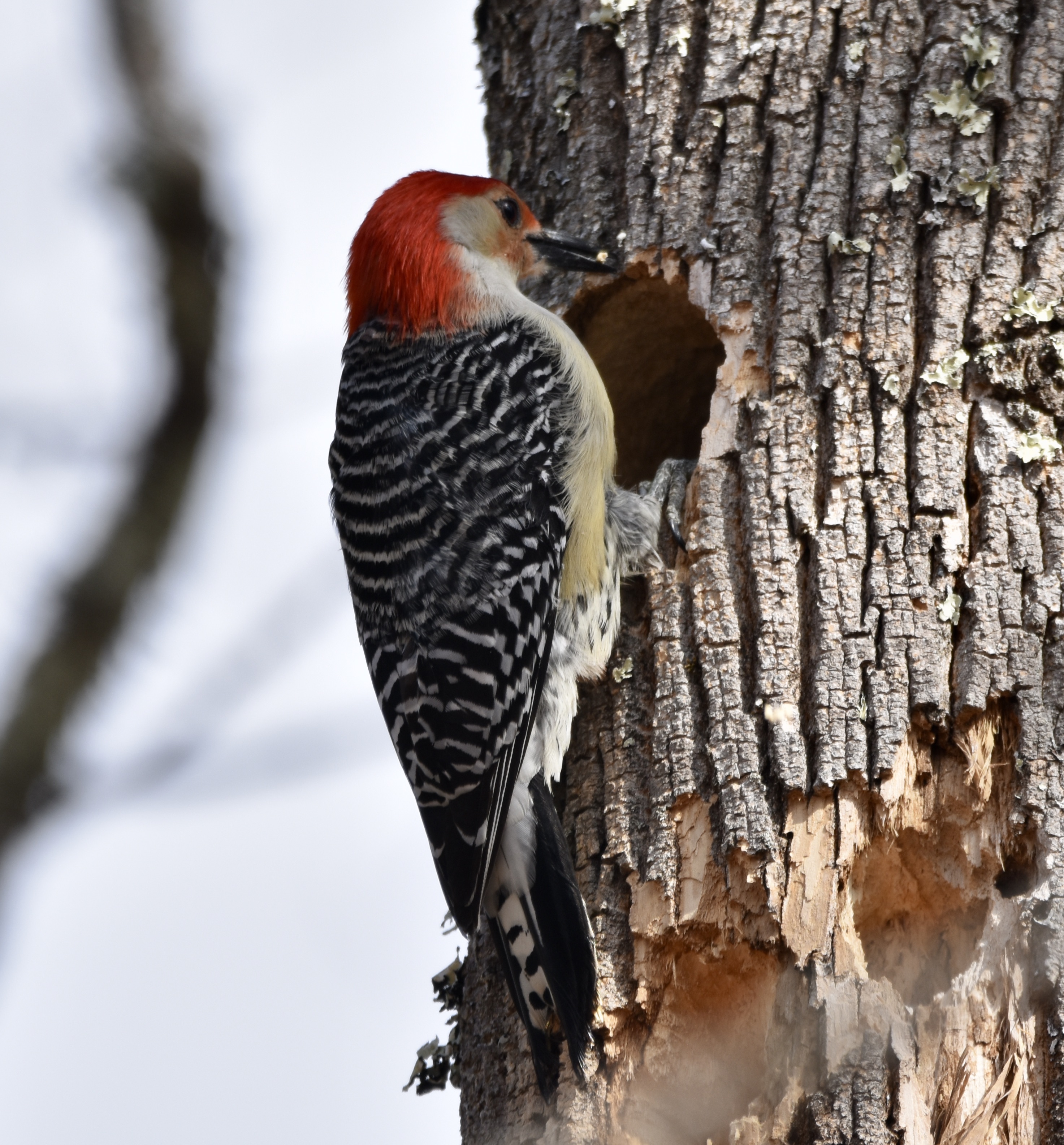
I settled in to watch this one hard at work. Over and over he pushed his head deep into the trunk and pulled out bits and pieces of wood. (You can see some in his beak in the last photo.) He was at it for quite some time!
Since then, I’ve been doing some research and it sounds like the male excavates the nesting cavity and then tries to entice the female. Oh, I do hope he’s successful! The nesting cavity is easily visible from the driveway and I’m already anticipating happy hours watching the family grow and taking photos along the way!
So, if all goes well, we’re expecting…baby woodpeckers!







 Nix the comfort zone