SOLC 2018–Day 8: Weather Sadist

11454297503_e27946e4ff_h

March 2018 SOLC–Day 8
A huge thank you to Two Writing Teachers for all that they do to create an amazing community of writers and a safe, welcoming space to write, learn, share and grow.
http://www.twowritingteachers.org

Have you noticed the pattern? Five or six days out there’s a fair amount of snow forecast. Everyone perks up at school, like dogs scenting squirrels. Snow day!?! Then, over the next few days, the forecasted snowfall totals move up and down, until finally the chance of snow evaporates… Until it reappears a few days later, about five days out.

Random pattern? I don’t think so! No, I’m pretty convinced that there’s a sadist who works in the weather department. I even think he may have been the one to come up with the idea of publishing a 10-day extended forecast. It gives him more range for his evil.

Here’s how I think it goes. At about 5 or 6 days out in winter, he plants the first seed. Rubbing his hands gleefully together, he slips in a forecast for snow, maybe 5-8 inches. I can just imagine the malicious gleam in his eye. Throughout the next few days, he manipulates that. A few inches up, a few inches down. He gets his thrills imagining teacher conversations. He  may even use his hands as puppets and speak his imagined dialogues aloud.

Hand one, falsetto: “Oh, do you think there’ll be a snow day next Tuesday?”

Hand two,  whiney falsetto: “It was 5-8 inches yesterday. Now it’s down to 3-5. I just don’t know…”

Hand one, despairingly: “Oh, nooooooooo!”

As the days pass, he plans and manipulates. He threads in just enough uncertainty to spice things up. “A slight change in the forecasted path could affect these totals…” or “There’s some disagreement among weather models…” 

Finally, one or two days ahead, he switches the forecast to 1-3 inches, or even to the dreaded < 1 inch, plummeting teacher hopes and dreams. When I see that forecast change, I swear I can hear maniacal laughter in the background.

“Bwahhh hah hah!!!”

But, not today. Today, I imagine the weather sadist sulking amidst his computers and weather reports, wringing his hands while teachers rejoice. For today is a 100% full fledged snow day!
SOLC 2018–Day 7: Golden Shovels

11454297503_e27946e4ff_h

March 2018 SOLC–Day 7
A huge thank you to Two Writing Teachers for all that they do to create an amazing community of writers and a safe, welcoming space to write, learn, share and grow.
http://www.twowritingteachers.org

I’m a huge fan of Michelle H. Barnes’ blog, Today’s Little Ditty. Her poetry is inspiring and her monthly author interviews are always engaging, amazingly informative and well crafted. At the end of her interviews, she invites authors to post a poem challenge for that month. Last month J. Patrick Lewis and Jane Yolen’s challenge was to write funny or clever epitaphs (here). This month Michelle interviewed Nikki Grimes (here), who challenged readers to use a line from one of the poems in the piece to write a golden shovel poem. This was just the push I needed, as I’ve been wanting to try a golden shovel poem for a while. (If you’re unfamiliar with the format, you can read a stellar explanation from Ms. Grimes at the end of the interview. Alternatively, if you just read the poems below, I think you’ll be able to figure it out.)

I took the line “a poem can split your skin” and laid it out on the righthand margin of my writer’s notebook. Then I got started. It was a very interesting process, almost like working backwards. Having your line breaks already in place, really impacts your piece, and creating a poem that doesn’t sound forced or contrived to fit this format is quite challenging.  Here’s my first effort:

The Power of a Poem

Like a tree root surging up through a
patch of asphalt, a poem
may persist until it cracks open your ribs. It can
expose your heart and split
your chest into sinew, bone, and skin

M. Hogan (c) 2018

“Truth by Tyrone Bittings” © Nikki Grimes, 2018
from BETWEEN THE LINES (Nancy Paulsen Books)

Then, I tried out another golden shovel using this line: “to strap on your own power”

Live!

This is your one life to
live. Strap
yourself in, hold on
tight and let yourself fly! Grow your
wildest wishes, create your own
wonderland, unleash your power!

M. Hogan (c) 2018

“Truth by Tyrone Bittings” © Nikki Grimes, 2018
from BETWEEN THE LINES (Nancy Paulsen Books)

I haven’t written much poetry since participating almost daily in Laura Shovan’s Ekphrastic Poetry Project last month. It felt good to get back into it and to attempt a new form.  On-line challenges like that project, the weekly 15 Words or Less prompt (Thanks, Laura Purdie Salas!), the Slice of Life and the monthly Ditty challenge really motivate me to write regularly and to stretch my writing muscles into new territories. I so appreciate the creativity and generosity of the involved authors.

SOLC 2018–Day 6: A Moment in the Cafeteria

11454297503_e27946e4ff_h

March 2018 SOLC–Day 6
A huge thank you to Two Writing Teachers for all that they do to create an amazing community of writers and a safe, welcoming space to write, learn, share and grow.
http://www.twowritingteachers.org

On lunch duty Friday, I was racing around the cafeteria, encouraging students to finish up lunch and keeping a loose lid on the bubbling chaos.

“Hey, Mrs. Hogan. Do you want to hear a joke?” B. called out as I rushed by him, bee-lining toward a rambunctious table.

Putting on the brakes, mentally and physically, I took a deep breath and responded,  “Sure, B.” Then, remembering my OLW for the year (pause), I took another breath and actually sat down on the stool next to him. 

“Who’s the best animal at playing baseball?” he asked me.

I thought for a moment. “Ugh, I should know this one, but I can’t think of it,” I said. “I give up. Who is the best animal at playing baseball?”

“A bat!” he crowed, eyes lit with laughter. “You know, like a baseball bat and a bat bat.”

“Oh, that’s right,” I said, smiling. “That one’s a classic! Do you have another one?”

He grinned at me. “Why don’t you want to play games with jungle cats?”

“Wait! I think I know this one,” I said. He graciously gave me some think time. All around us children chatted and laughed and knives and forks clattered on trays. Finally, I suggested, “Because they’re always lion?”

“No! Because they’re cheetahs!” he said.

We both laughed.

“Thanks, B.” I said, but I didn’t immediately get up to rush away. I just sat by him for a few minutes longer, enjoying the moment, pausing in the midst of the day.

SOLC 2018: Day 5–Andrew Wyeth-Potential Slicer?

11454297503_e27946e4ff_h

March 2018 SOLC–Day 5
A huge thank you to Two Writing Teachers for all that they do to create an amazing community of writers and a safe, welcoming space to write, learn, share and grow.
twowritingteachers.org

Screen Shot 2018-03-04 at 3.58.36 PM.png

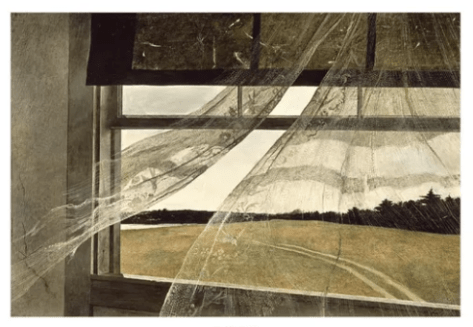
Andrew Wyeth, Wind from the Sea, 1947

Yesterday I wrote a slice about a small moment in the local post office in which an impromptu discussion of all things Andrew Wyeth was sparked by a sheet of stamps featuring his paintings. As I looked up an image of “Teel’s Island” to add to that post, I took some time to scroll through images of other Wyeth paintings. I was struck by how many of them captured the intimacy of a setting or a moment but were rich with deeper layered meaning. There is such a sense of story and mood in his work. Suddenly it struck me: If Andrew Wyeth had been a writer, he’d have been a Slicer!

That thought was enough to send me down a rabbit hole. I started reading a bit more about Wyeth and everything I read confirmed this thought. For example, Wyeth himself said, “I paint my life.” Change “paint” to “write” and you’re slicing! He focused on the land, people and objects around him, both in Maine and in Pennsylvania. His focus on rendering these everyday scenes with exquisite detail reminds me of the best small moment stories– Both recognize the potential of a moment in time and then carefully craft a piece that captures and transcends that moment. Wyeth’s work is imbued with emotional resonance. It pulls me in.

IMG_2568.jpg

Andrew Wyeth, Alvaro and Christina, 1968

larger

Andrew Wyeth, Teel’s Island, 1954

Interestingly, even with his focus on everyday objects, realistically portrayed, Wyeth considered himself an abstractionist rather than a realist.

“My people, my objects breathe in a different way: There’s another core–an excitement that’s definitely abstract. My God, when you really begin to peer into something, a simple object, and realize the profound meaning of that thing- if you have an emotion about it, there’s no end.”

That says it all, right?

And then in one of those wonderful serendipitous moments, while I was reading about Wyeth, I stumbled upon the fact that there was an ongoing exhibit of his drawings at the Farnsworth Museum in Rockland, Maine. Quickly I checked the exhibit dates: Opened September 15, 2017. Closing Sunday, March 20th.

So, guess where I went yesterday!


SOLC 2018–Day 4: A Slice from the Post Office

11454297503_e27946e4ff_h

March 2018 SOLC–Day 4
A huge thank you to Two Writing Teachers for all that they do to create an amazing community of writers and a safe, welcoming space to write, learn, share and grow.
twowritingteachers.org

IMG_2539 (2).jpg

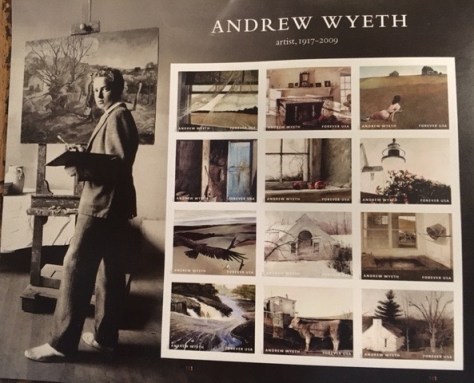
One of the bonuses of small town post offices is that the line is rarely long. On this particular Saturday morning, other than the woman being waited on, there was only one man in line in front of me. He was somewhat disheveled, gray haired and bearded, wearing well-worn jeans. As the first customer gathered up her stamps and moved away, he stepped forward to the counter.

“Do you have the Wyeth stamps?” he asked. My ears perked up. Wyeth stamps?

“Let me see.” The clerk riffled through her drawer and then pulled out a sheet of stamps. “Here you go,” she said, handing them to him.

“What’s your favorite?” he asked her, reaching out to take the sheet. “The cow?”

“No,” she said. “I’m not sure. I have a print of the dog on a white bed at home. But that one’s not here.”

download-1.jpg“Oh, I love that one,” I chimed in.

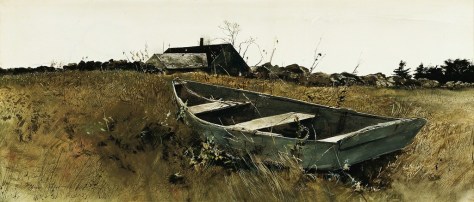
The man shifted to the side to include me in the conversation. “Have you ever seen the one with a skiff pulled up on shore?” he asked us. “And there’s a house up over the knoll…”

We both shook our heads, unfamiliar with that particular painting.

“It’s called Teel’s Island,” he said. “It’s a watercolor.”

We spent the next several minutes discussing Andrew Wyeth, the Farnsworth museum, the Olsen house and our favorite Wyeth paintings. Three strangers in a rural Maine post office on a Saturday morning. Then the man paid for his stamps and left. I requested and paid for my own sheet of Wyeth stamps and went on my way.

Later that day, I went online and did a quick google search for Teel’s Island. The image, quintessential Wyeth, filled the screen. There was the skiff the man had mentioned…the knoll…the house–Each detail adding to a whole that was considerably greater than its parts. I now count it among my favorites.

Clearly, there’s more than one bonus to small town post offices.

larger.jpg

Teel’s Island by Andrew Wyeth, 1954

Note: A big shout out to Cindy at Mainer in Training. Thanks, Cindy! Her wonderful recent slice, Christina’s World, reminded me of this moment. If you have a chance, be sure to stop by and check it out!

SOLC 2018–Day 3: It’s a Nickname

11454297503_e27946e4ff_h

March 2018 SOLC–Day 3
A huge thank you to Two Writing Teachers for all that they do to create an amazing community of writers and a safe, welcoming space to write, learn, share and grow.
twowritingteachers.org

515BixCGnvL._SX258_BO1,204,203,200_.jpgTables lined the hallway, covered with an assortment of paper backs and picture books from last night’s Read Across America celebration. As we walked by on our way to recess, my fourth graders eyed the books. K started giggling, nudged her friend and pointed to the first word in a large hardcover titled “Dick and Jane and Friends.”  Her friend smiled but didn’t respond much.
As we exited the building, K approached me. “Mrs. Hogan, one of the books back there had the “d” word on the cover!”

I felt fortunate that I actually knew what she was talking about.

“Yup,” I said, “That’s a name. It’s actually a nickname for Richard.”

“What!?!” she cried. Her face was a mirror of astonishment with “You have to be kidding me!” written all over it.

“Yeah,” her friend chimed in, “I have an uncle with that name.”

“I have an Uncle Dick, too,” I added.

K. looked back and forth between the two of us skeptically, weighing whether to believe us or not.

“Well,” she finally announced emphatically, “If I ever have a child and name him Richard, I am NEVER EVER going to use that nickname for him!”

Then she swept outside for recess.  I laughed the whole way back to the classroom.


Finishing out February

unnamed

This week marked the official end of Laura Shovan’s February Poetry Project. Heading back to school after break and starting up the Slice of Life Challenge this week impacted my poetry writing, and not for the better.  Here are a couple of my ekphrastic poems from the past week. Considering how much I’ve enjoyed this month, I expect they won’t be my last!

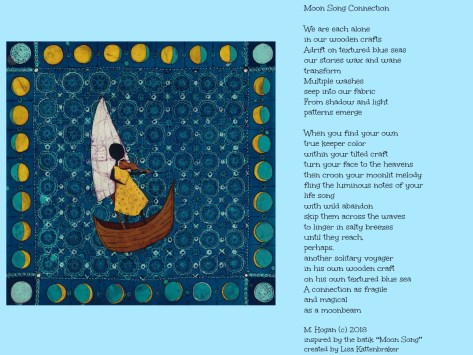
Moon Song Connection.jpg

Moon Song Connection

We are each alone
in our wooden crafts
Adrift on textured blue seas
our stories wax and wane
transform
Multiple washes
seep into our fabric
From shadow and light
patterns emerge

When you find your own
true keeper color
within your tilted craft
turn your face to the heavens
then croon your moonlit melody
fling the luminous notes of your life song
with wild abandon
skip them across the waves
to linger in salty breezes
until they reach,
perhaps,
another solitary voyager
in his own wooden craft
on his own textured blue sea
A connection as fragile
and magical
as a moonbeam

M. Hogan (c) 2018
inspired by the batik “Moon Song”
created by Lisa Kattenbraker

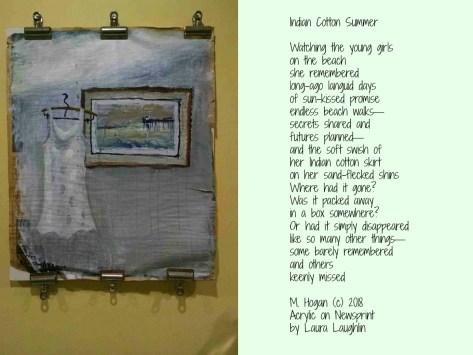
Indian Cotton Summer.jpg

Indian Cotton Summer

Watching the young girls
on the beach
she remembered
long-ago languid days
of sun-kissed promise
endless beach walks—
secrets shared and
futures planned—
and the soft swish of
her Indian cotton skirt
on her sand-flecked shins
Where had it gone?
Was it packed away
in a box somewhere?
Or had it simply disappeared
like so many other things—
some barely remembered
and others
keenly missed

M. Hogan (c) 2018
Acrylic on newsprint
by Laura Laughlin

This week’s Poetry Friday Roundup is hosted by Renée LaTulippe at her blog, No Water River. She’s highlighting poet extraordinaire, Michelle Heidenrich Barnes. Be sure to stop by and visit!


SOLC 2018–Day 2: Past Present Future

11454297503_e27946e4ff_h.jpg

IMG_2518.jpg

Fish swim across the woven cotton. Faded whites on a deep aquatic blue. Somehow the dress has moved with me from place to place, year after year, surfacing periodically. I’d almost forgotten about it until now, when my daughter, Adeline, pulls it from the depths of her closet.

“Mom, do you want to keep this?”

I turn to face her, catching sight of the dress.

A small “Oh!” escapes me. Then I gather myself. “I don’t know,” I say. “It seems kinda silly, really. I’ve just been holding onto it for all these years. I don’t think I’ve even worn it.”

“Didn’t your mom make this?” she asked

“Yeah.”

“Well, does it fit you?”

“I don’t know. I think I tried it on years ago and it was a little tight. I’m not really sure.”

“Try it on,” she urges, handing me the dress.

I take it from her and go to my room, holding it in my hands. Wow. This dress must be around 40 years old. So long ago, my mom’s hands chose this fabric, cut the patterned pieces and stitched the cloth into this final garment. I have a vague memory of her wearing it–tan skin against the batik, a flash of a smile, frosted hair– but I’m not sure if it’s real or imagined.

I slip out of my clothes and pull the dress on over my head, tugging it down to slide over my hips. I look in the mirror, turn to one side and then to the other. It fits snugly through the bodice, but falls loosely from the waist to my ankles, swaying about my legs. It’s a simple cut, timeless.

I return to Addie’s room.

“What do you think?” I ask. Again, I turn from side to side, the full skirt of the dress swishing.

“It’s cute,” she says. “You should keep it.”

I look at my daughter in the midst of her really-moving-out-for-good room cleaning. My daughter who never met the grandmother who created this dress. How interesting that it reappeared today, on the eve of her departure.

Again, I touch the fabric, taking comfort from its soft cotton and from its connection. Past–present–future. Woven together in this moment.

Of course I’m going to keep it.


SOLC 2018–Day 1: Think Before You Speak

11454297503_e27946e4ff_h.jpg

March 2018 SOLC–Day 1
A huge thank you to Two Writing Teachers for all that they do to create an amazing community of writers and a safe, welcoming space to write, learn, share and grow.
twowritingteachers.org

“I gave it to you,” the man insisted to the bartender. His belligerent tone caught my ear, and I glanced over.

“No,” the bartender said, calmly,  “I ran your card through the machine and then gave it right back to you.”

“No. You. Did. Not.” he stated emphatically, his voice raising slightly with each word. He was older, well-dressed, and visibly irate.  The tension in the air was palpable. The few customers in the cafe shifted in line and glanced at each other uneasily.

He continued, spitting words like shrapnel, “You asked me if I wanted to start a tab and I didn’t want to give it to you but I did. I told you the card was cracked at the bottom and to be careful.”

The bartender looked around her as he spoke, lifting menus and other small items, double checking. “It’s not here,” she said again.

After a few more protests and angry complaints, the man retreated to his table at the far side of the room. His group began pushing back chairs and putting on their coats, apparently heading to the 7 pm documentary showing in the attached cinema. The rumble of his irritation buzzed audibly in the room and I imagined he was sharing his outrage with his dinner companions. There was a pause and then I heard a faint, more moderately toned, “Where did you find it?”

“I think he found his card,” I said to the bartender as I ordered my tea.

“That’s good,” she said. She didn’t even roll her eyes. Class act.

I wondered if the man would come over and apologize, though clearly he wasn’t in a rush to do so. After a few minutes passed, I realized I might have misconstrued what I’d heard. Perhaps he hadn’t found his card after all. He continued to talk with his companions. I paid and gathered my change and tea, and headed to my group’s table.

A few minutes later, I noticed the man was at the bar again, talking to the bartender.

“That’s ok,” I heard her say. “Not a problem.”

Once again, I admired her graciousness (and wondered if she was repeating “The customer is always right” in her head over and over). I also wondered what exactly the man was apologizing for. I suspect he was apologizing for insisting she had his card although she did not. From what I overheard, it sounded more like he was excusing his mistake, rather than really apologizing for his words or his behavior.  He clearly was not apologizing for how he spoke to her. Did he even recognize how rude he had been? How berating and aggressive his tone was?

There were two players in this scene—the bartender and the man. One problem—the missing card. They each chose how to respond. She clearly took the high road. He didn’t. Maybe he’d had a bad day. Maybe something else was going on. But, the bottom line is that he was far more concerned about his credit card and its potential loss and his emotional response to that than he was about how he chose to interact with another human being. In my book, that’s a huge problem. It’s okay to be mad. It’s okay to be frustrated. It’s not ok to splash your emotional upset over others without any consideration. Especially over a missing credit card. It just doesn’t work that way. Or at least it shouldn’t.


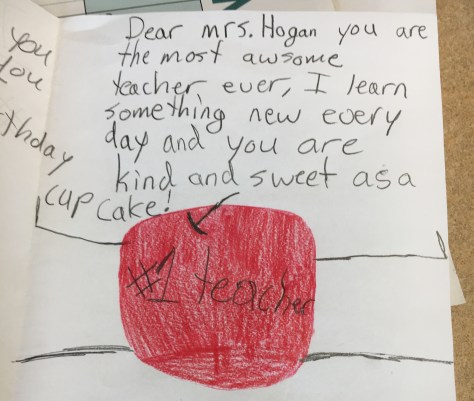
Sweet as a cupcake–a slice from earlier this month

11454297503_e27946e4ff_hK. wandered up to my desk at the beginning of the day. She touched a tulip blossom.
“Oh, these are pretty! Why do you have flowers?”

“Mrs. V. gave them to me for my birthday,” I replied.

“It’s your birthday?” she asked, looking at me incredulously.

“Yes,” I said.

“You’ve got to tell everyone!” she insisted.

I laughed. “It’s not a secret,” I said, “but I don’t think I need to announce it.”

She stared at me for a long moment. Clearly this idea defied comprehension. “How old are you?” she finally asked.

“51.”

“Oh,” she said. Then she repeated, “You’ve got to tell everyone it’s your birthday! Are you going to tell them at morning meeting?”

“Probably not,” I said, then laughed again at the expression on her face.

Later that morning after I walked my class out to recess, I returned to the room and sat down at my desk. There atop my stack of papers was a homemade birthday card. The cover was decorated with a picture of a cake emblazoned with the number 51. Inside was a cute drawing of a cat. Smiling, I remembered snack time and K asking me “casually” about my favorite animal. How did she manage to make that card without me noticing?

Heading back from lunch, I thanked her, “K. I love my card–especially the cat! Thank you so much!”

She beamed. Then she glanced at me sideways and confided, “I might have told a few people about your birthday.”

By the end of the day a small collection of surreptitiously created cards was piled on my desk. A sweet birthday surprise. Thanks, K!

IMG_2477.jpg