Pause

11454297503_e27946e4ff_h

This April, Renee LaTulippe of No Water River is hosting a wonderful month of poet visits and writing prompts. I’ve been lurking mainly, but a prompt from Margarita Engle caught my eye. She asked poets to write about making a choice, either simple or complex. Here’s one I made recently on the way home from work.

DSCN2968.jpg

Pause

Driving home last night
I chose to pause
to pull over on the berm
then sit and watch as
four slender deer
foraged in the misty fields
while cars whizzed by
buffeting me with their wake

Last night
I chose to linger
while deer peacefully grazed
stepping through
tendrils of languid fog
that drifted and twined about them
concealing
revealing
as the world rushed by
and dusk descended.

© 2018 M. Hogan

DSCN2974.jpg


Ripples


unnamed

DSCN3154.jpg

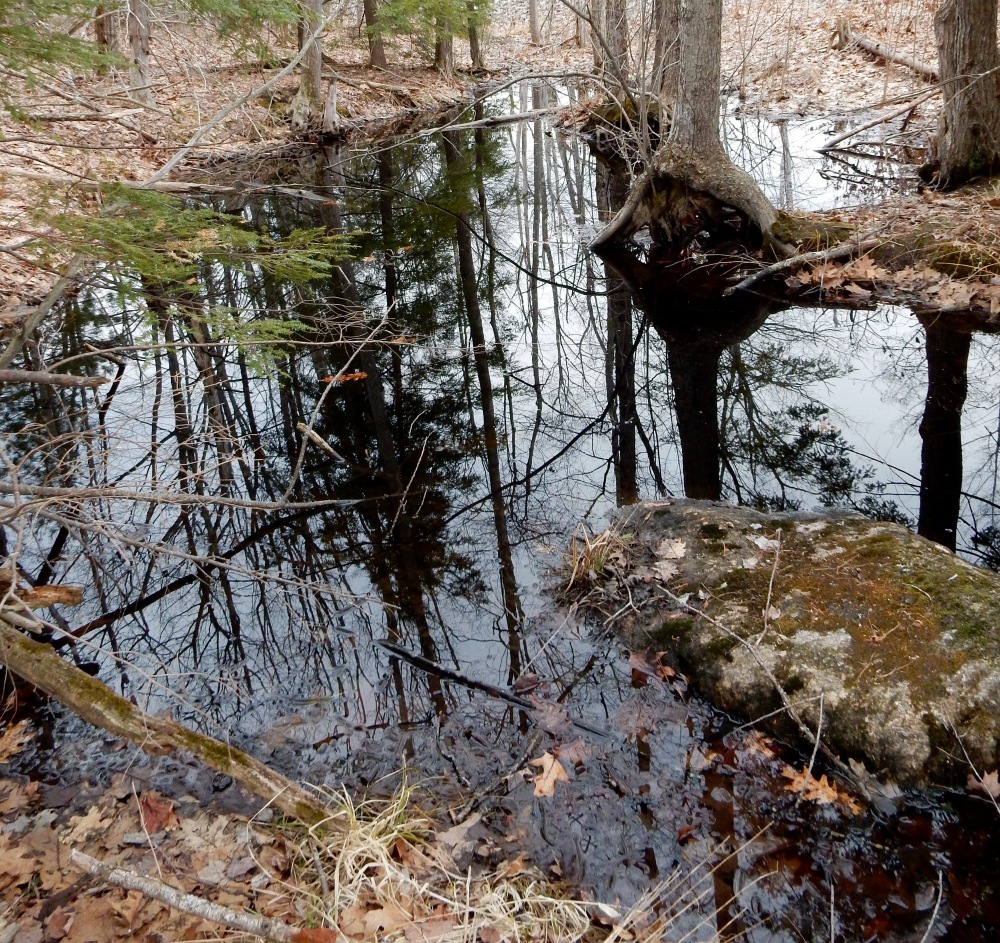
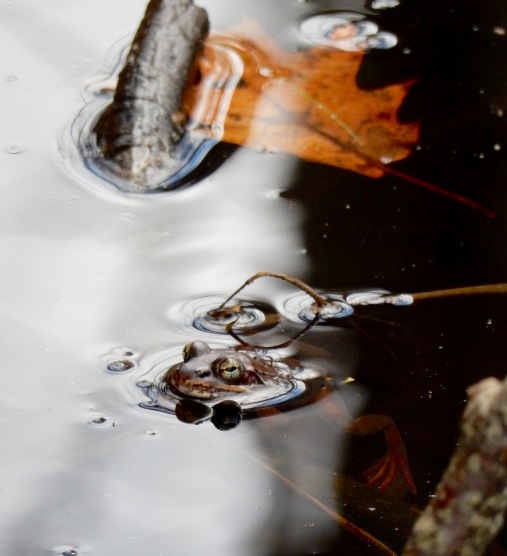
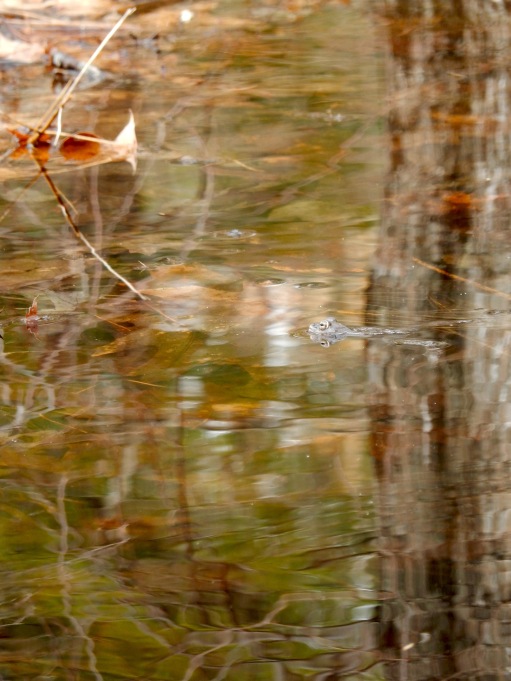
Taking pictures of frogs is one of my favorite spring activities, and during this week’s break, I’ve been haunting two local vernal pools. Sometimes finding frogs is like completing a hidden picture puzzle. You look and look and don’t see any, and then suddenly realize there’s one over there. Oh! Then, there’s another! And another! Then, the challenge is to get a picture of them without scaring them away.  I’ve had limited success this year (I don’t think the frogs like the miserable weather either!), but have had great fun searching. I love using photos with poetry and thought this week I might use one of my new pictures to inspire a poem about frogs.

Then the other day, I finally had the chance to dive into Amy Ludwig VanDerwater’s book, Poems Are Teachers. What an inspiration!  I haven’t read far (too many spring break “field trips”!) but am loving it. It’s an incredibly rich brew of resources spiced with Amy’s passion for and knowledge about poetry. I’m struggling to find the superlatives to do it justice, but the bottom line is, I think this book will have a major impact on both my teaching and my writing.

Anyway, while I was toying with the idea of writing a frog-inspired poem, I read Chapter 1, and Mary Lee Hahn’s words struck me. “When I choose a photo, I notice everything in it. Then I think about who or what might be just outside the edges of the photo.” Her words inspired me to go back to some recent frog photos and push outside the edges of the image, in search of a poem.

DSCN3172 (1).jpg

Ripples

I step off the river path
into cool shadows
My eyes skim the vernal pool
seeking irregularity
a broken plane
on the leaf-lined pond
where light freckles the surface
tree shadows criss cross and
reflections run riot
searching, searching
’til..
there!
The bump of your eyes
catches mine
I crouch, snap a photo
then step forward eagerly
too eagerly
and with a splash you dive
your pale amphibian legs
flexing and pushing
ghostly shadows in the murky water
’til you vanish from sight
only ripples mark
where once you were

©2018 M.  Hogan


DSCN3293.jpg

DSCN3300.jpg

This week’s Poetry Friday Roundup is hosted by Tabatha Yeatts at her blog, The Opposite of Indifference. Tabatha is also celebrating the release of IMPERFECT: Poems about mistakes for middle schoolers. I’m thrilled to have a poem included in this collection. Woohoo! Pssttt—There are even rumors about a party! Head on over so you don’t miss the fun!

The Moon

DSCN8390.jpg

Today J. Patrick Lewis offers a sneak peek at his newest book, PH(R)ASES OF THE MOON: LUNAR POEMS at Renee LaTulippe’s blog No Water River. He also posts an invitation to contribute a moon-inspired poem to the community collection. I shared a moon poem quite recently (here) and wanted to revisit the idea of the moon as a weaver. Here’s my response to his prompt.

The Moon

Bright skeins of moonbeams at her feet
She weaves a lacy night replete
with shadows deep and paths aglow
and nimbly crafts a lustrous flow
a gleaming throw o’er sleeping land
moon magic streaming from her hand

©2018 M. Hogan


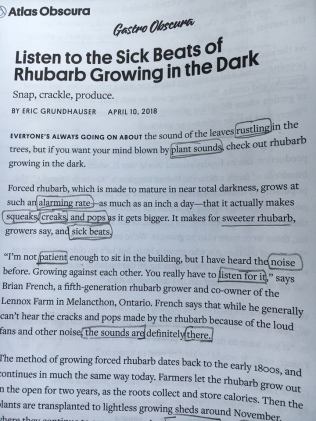
Listen! Rhubarb’s growing!

I’ve been wanting to write a found poem for a while. Then recently, an Atlas Obscura article appeared in my Inbox. It was all about listening to the noises that forced rhubarb makes when it grows. What?! Yup. You read that correctly. When forced to grow in the dark, rhubarb grows up to an inch today and makes audible sounds as it grows. Take a listen.

Crazy, right? Who could resist the urge to write a poem about that? Not me! I was utterly entranced and once I read the accompanying article, I thought a found poem would be just the ticket.

rhubarb.jpg

Rhubarb Growing in the Dark

Rustling
plant sounds
alarming rate
squeaks, creaks, and pops
sweeter rhubarb
sick beats
patient noise
listen for it
the sounds are there
out of season
in the dark
deep red stalks burst
distinct popping
squeaks and creaks
right tight to one another
sounds stand out
turn all the power things off
sit
relax
listen

©2018 M. Hogan

a found poem inspired by an Atlas Obscura article, “Listen to the Sick Beats of Rhubarb Growing in the Dark” by Eric Grundhauser

Then ( because how often do you get to write a poem about rhubarb?), I had to write another poem.

Rhubarb-Spring

Snap!
Crackle!
Tart red juicy stems
Pop!
forced to grow in darkness
cramped and crowded
They gripe, groan, and grow
with audible pain
a chorus of complaint
or…
could this be a song?
Perhaps they rejoice
stretching their stalks
celebrating the season
nudging into neighbors
jubilant in their growth
singing a song of rhubarb-spring

©2018 M. Hogan

Note: In a happy little moment of serendipity, my poems meet two Poetry Month challenges today. “Rhubarb Growing in the Dark” meets Georgia Heard’s prompt for a Found Poem on Renee LaTulippe’s Poetry Month Challenge at her blog, No Water River. “Rhubarb-Spring”  accepts Amy Ludwig VanDerwater’s invitation to write a “Title From The Text” poem in which you take a title from the text of your poem after you have written it.

Anticipating Spring

unnamed

DSCN3085.jpg

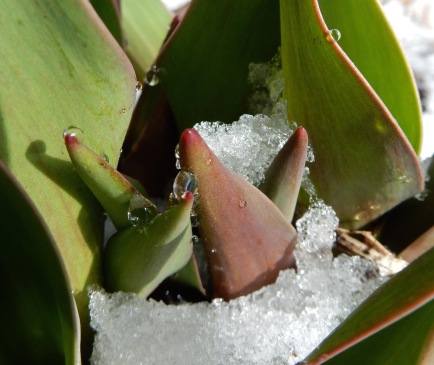
Now that the temperature is slightly more welcoming and the snow pack has receded, I’ve been spending more time outside. In addition to enjoying the fresh air and scouting out subtle signs of approaching spring, I’ve been taking pictures again. I hadn’t realized how much I’d missed it! Here are three short spring- and photo-inspired poems from the last week.

Spring Prophecy.jpg

Spring Prophecy

Along winter-bare branches
twilight raindrops
sparkle like blossoms

©2018 M. Hogan

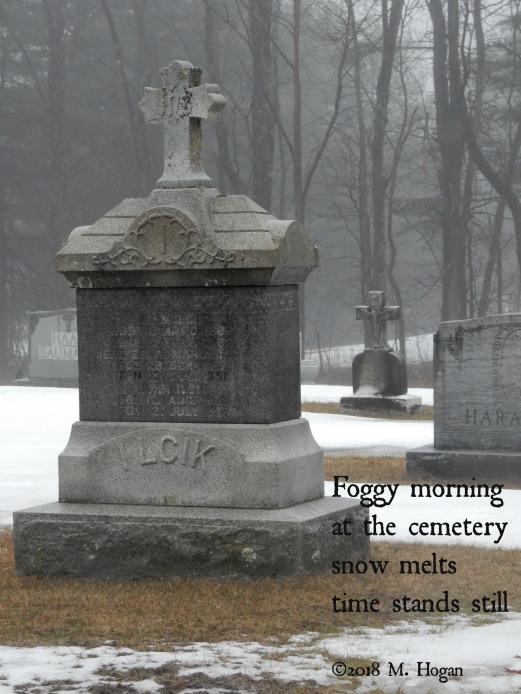
Cemetery.jpg

Foggy morning
at the cemetery
snow melts
time stands still

©2018 M. Hogan

Unfortunately, I wasn’t able to stop and take a photo, but as I drove to work this week, I noticed this welcome sight:

Migrating birds perch
among emerging spring buds
like precocious blossoms

©2018 M. Hogan

And finally, a big happy birthday wish to Lee Bennett Hopkins, poet and anthologist extraordinaire. While searching for signs of spring and all things “spring-ish”, I found his poem, Spring. I love the rhythm of it!

SPRING
by
Lee Bennett Hopkins

Roots
sprouts
buds
flowers

always–
always–
cloud-bursting showers…
(click here to read the entire poem)

You can find the Poetry Friday Roundup this week at the talented Robyn Hood Black’s blog, Life on the Deckle Edge. She’s also hosting the surprise birthday celebration for Lee Bennett Hopkins, so make sure to stop by and join in the birthday festivities!

Moonlight

unnamed

moonlight1.jpg

Moonlight

As shadow clouds drift apart
Moonlight’s nimble fingers
cease their dream knitting
to flow through rain-dappled windows
and pool on pine floors
in a quicksilver puddle
then inch like the tide
from floor up over rumpled sheets
until they brush my slack cheek
dust my eyelashes with moonbeams
and nudge me from slumber
to marvel at their beauty

©2018 M. Hogan

This week’s Poetry Friday Roundup is hosted by the amazing Amy Ludwig VanDerwater at her incredible blog, The Poem Farm. Make sure to take some time to investigate and savor her site. It is an incredible resource for students, teachers and lovers of poetry.

SOLC 2018–Day 31: Pet Peeves of Aging

11454297503_e27946e4ff_h

March 2018 SOLC–Day 31
A huge thank you to Two Writing Teachers for all that they do to create an amazing community of writers and a safe, welcoming space to write, learn, share and grow.
http://www.twowritingteachers.org

The challenge ends today. I’m another month older, and hopefully another month wiser. This morning after a glance in the mirror at my sleep-creased face, I started thinking about getting older.  Mostly I’m ok with it (I mean the alternatives aren’t great!), but there are a few areas that bug me.

1. Hair. I’m fine with gray hair, but who decided that renegade hairs should start appearing in odd places and grow exponentially?  Even when vigilant about checking, I can find a robust black hair a half inch long protruding from my face or neck. It’s appalling! I can’t help but wonder how many other people have seen that hair and thought, “Gee, I wonder why she doesn’t pluck that?” I’ve already warned my children that I’m going to draw them a map of all the likely spots for those hairs, and when I’m in the nursing home, unaware, it will be their job to pluck them.

imgres-2.jpg2. My skin. Why didn’t I appreciate my skin when it was flexible and smooth?  Now I have thigh skin that cascades over my knees and after four babies, the skin on my stomach resembles that of a sharpei. Sigh. Dimples and dents have replaced peaches and cream.

3. Grooves. I can  handle wrinkles–those character lines that fan out from my eyes or bracket my smile. But who decided to put a canyon between my eyebrows? Actually, it’s two canyons!  Do I really frown that much or constantly furrow my brow?  I think I’m generally a happy person, but these deep, abiding frown lines make me doubt myself. And what’s up with that new charming horizontal line between my upper lip and nose?images.jpg

4. Changes in Memory. I swear I spend half my time continuing to walk down hallways or into rooms hoping that I’ll see something that will jar the memory of my original intent. Sometimes it happens. Sometimes it doesn’t. And don’t even get me started on word retrieval! Thank God I now have a trove of slices that can remind me what happened during this past month.

Writing about memory, reminded me of an aging-related poem I wrote a few years ago. Ending with that seems like the perfect segue from this month’s challenge to Poetry April.

Happy Writing and thanks to all for a most memorable month!

The Battle

There once was a hair on my chin
undetected when first it grew in
I noticed it there
Adrift in the air
And yanked it out with great chagrin.

Another one grew on my cheek.
(It happened in less than a week!)
I pulled that one too
without great ado
But with a full bellicose shriek.

It’s said that in some far-flung places
Facial hair adorns women’s faces
But I can’t sport a ‘stache
with elan or panache
I vow to remove any traces.

My tweezers now flash through the air
Extracting each invading hair
There is not a thing cute
’bout my face so hirsute
I battle with growing despair.

Each day my reflection as mirrored
Shows renegade hairs have appeared
My expression is grim
As I tweeze and I trim
Not resigned to displaying a beard.

I continue the gods to implore
to vanquish these whiskers galore
They’re more apt to dispatch
A peach-fuzzy soul patch
I win battles but never the war.

Molly Hogan (c) 2016


Ladybug

unnamed

Each fall the ladybugs gather in the corners of our house. Whenever I see one, I think of the childhood lines, “Ladybug, ladybug, fly away home. Your house is on fire, your children alone.” This year I realized two things: One, this verse is really quite grim, and two, I wasn’t sure how the rest of it went, though I felt sure that there was more. So, I looked it up and learned a few things along the way. For example, did you know that ladybugs are referred to in Great Britain as “lady birds”? The most common version of the verse, traced back to 1750s England, goes like this:

Ladybird, ladybird fly away home,
Your house is on fire and your children are gone,
All except one,
And her name is Ann,
And she hid under the baking pan.

That ending didn’t sound familiar to me at all! There are many, many versions of this verse, some much grimmer (“your children will burn!”) and there’s also much debate about its origin. Was it chanted by farmers warning ladybugs to flee before burning the fields after the harvest? Was it a warning to pagans to go underground? Was it sung out to warn Catholics who participated in illicit celebrations of Mass in farmer’s fields?

And that isn’t all!  Ladybugs have symmetrical spots, and many cultures consider them lucky. In the Netherlands the ladybug is used as an anti-bullying symbol and to raise awareness for the National Foundation against Senseless Violence. Tiles like this can apparently be found on streets and paths, and sometimes they’re placed at the site of a violent crime.

220px-2008-09_alphen_geen_geweld
I also came across this verse, published in Favorite Poems Old and New, Selected for boys and girls, selected by Helen Ferris. As I read, I was at first charmed but the ending has a darker tone. (For a lucky bug, there don’t seem to be too many happy verses around!)

Lady-bird, Lady-bird, fly away home
the field mouse is gone to her nest
the daisies have shut up their sleepy red eyes
and the birds and the bees are at rest
Lady-bird, Lady-bird, fly away home
the glow worm is lighting her lamp
the dew’s falling fast, and your fine speckled wings
will flag with the close clinging damp
Lady-bird, Lady-bird, fly away home
the fairy bells tinkle afar
make haste or they’ll catch you and harness you fast
with a cobweb to Oberon’s star

DSCN1823

The ladybug pictured above obliging posed for me while climbing on the plant in my bathroom. The black bat-like mark on her “face” made me think of superheroes, while echoes of that childhood verse lingered in my mind. One more not-so-cheery verse for the ladybug!

Valiant ladybird
spreads crimson carapace
soars to the heart of the blaze
to rescue children
who are already long gone

Molly Hogan (c) 2017

This week’s Poetry  Friday Roundup is hosted by Lisa Coughlin at her blog, Steps and Staircases. Make sure to stop by and check out some poetry.


Abandoned Farmhouse

 poetry-friday-logo-300x205
Abandoned Farmhouse
by Ted Kooser
He was a big man, says the size of his shoes
on a pile of broken dishes by the house;
a tall man too, says the length of the bed
in an upstairs room; and a good, God-fearing man,
says the Bible with a broken back
on the floor below the window, dusty with sun;
but not a man for farming, say the fields
cluttered with boulders and the leaky barn.
…..

(click on the title to read the remainder of the poem)

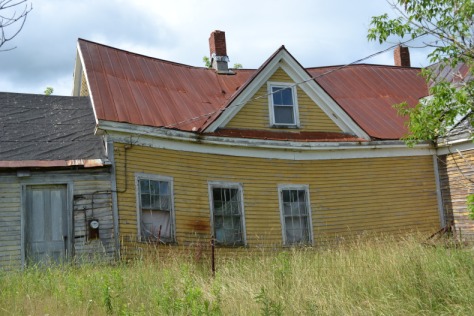
house3.jpgI read the above poem recently and thought immediately of the abandoned houses that haunt the back country roads in Maine. Their stories are palpable. Ted Kooser imagines one story, with an ominous tone, in a setting spiked with broken dishes and spines, boulders and leaky barns. His poem inspired me to revisit an old post and some pictures I’d taken long ago, and to write the following:
house2.jpg

Once upon a time…

The house had good bones
its story still stirs the air
like a haunting whisper
Once upon a time…

Big house
little house
back house
barn
like vertebrae on a spine
skinned with a coat of cheerful yellow
crowned with a jaunty red roof
waving a welcome
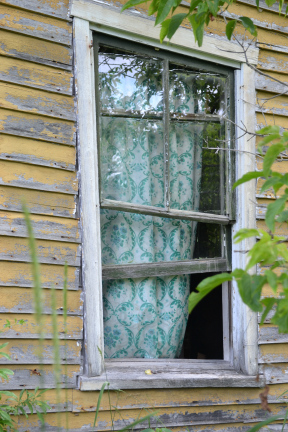
with blue and white curtains
at its windows

Now, open windows are blank eyes
Dulled yellow paint
peels from bone-dry clapboards
the red roof bucks and heaves
a fractured spine

No bark echoes in this yard
No drying clothes dance in a soft spring breeze
No child’s laughter trills
Even the birds seem silent here

Look
Listen

In a gaping window
the dusty curtains flutter
like a broken sigh

There is no graveyard
for houses that die

Molly Hogan (c) 2017

If you’re interested in learning about the “big house, little house, back house, barn” architecture so evident in Maine, click  here. If you’d like to read some more poetry at this week’s Poetry Friday Roundup, head over to A Year of Reading.